


German B1 listening practice is one of the skills that many learners find difficult when they begin preparing for the B1 exam. At this level, listening content is usually faster, sentences are longer, and there are more expressions that are closer to real-life communication. So how should you practice German B1 listening to improve? Should you combine listening with German B1 reading practice or learn through German B1 grammar listening exercises? And is the German B1 exam difficult if your listening skills are still weak? The following article will help learners build a suitable practice method.
Is German B1 listening practice important?
At B1 level, learners need to be able to understand familiar content in everyday life, study, and work. When listening to a dialogue or announcement, the goal is not to identify every single word accurately, but more importantly to understand the topic, main information, and necessary details.
Therefore, German B1 listening practice plays an important role in developing German language skills. By regularly listening to audio, learners gradually become familiar with speaking speed, pronunciation, intonation, and expressions commonly used in communication.
What skills does German B1 listening practice improve?
Regular listening practice helps learners improve their ability to recognize vocabulary in real speech. A word may be very familiar when seen on paper but become difficult to recognize when it appears in a fast-paced conversation.
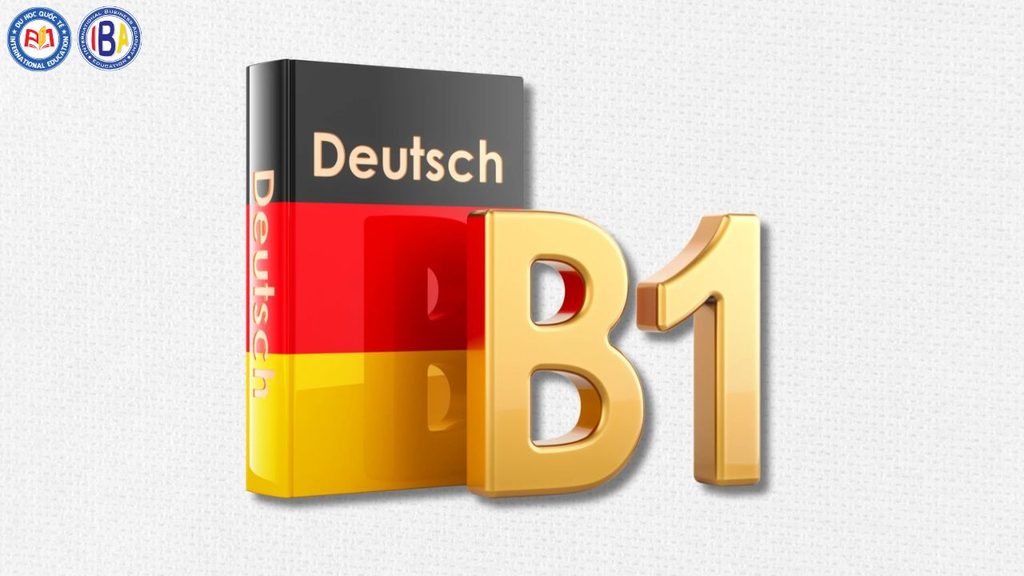
In addition, German B1 listening practice helps learners identify the main idea, recognize important information, and respond more quickly to questions. It also provides a foundation for speaking skills because extensive listening gives learners more opportunities to hear how native speakers construct sentences and use words in different situations.
Why can you know a lot of vocabulary but still have poor German B1 listening skills?
A common reason is that learners only memorize words through their written forms. When listening, the sound of a word may differ from what the learner imagines, especially when the speaker links sounds or speaks quickly.
Another reason is that learners often try to translate every sentence into Vietnamese. This approach slows down processing and can easily cause them to miss the next piece of information.
Instead of trying to understand every single word, learners should focus on keywords, context, and the speaker's purpose. This is one of the important principles of German B1 listening practice.
German B1 listening practice by question type
One effective way to improve listening skills is to divide listening content into different types. Each type requires learners to focus on a different kind of information.
German B1 listening practice for identifying the main idea
In this type of exercise, learners need to determine what the listening passage is about. It is not necessary to understand the entire content.
For example, a dialogue may be about changing an appointment. Learners only need to identify who is speaking, when the original appointment was scheduled, and why it is being changed.
When practicing German B1 listening, make it a habit to ask yourself:
- What is the topic of the listening passage?
- What issue is the speaker discussing?
- What is the purpose of the conversation?
- What information is repeated or emphasized?
German B1 listening practice for finding detailed information
This type requires a higher level of concentration. The information to find may include time, location, price, quantity, reason, or plans.
Learners should read the questions before listening so they know what information to look for. When the audio starts, they should not try to remember everything, but focus only on keywords related to the questions.
German B1 listening practice through dialogues and announcements
Dialogues often contain more natural expressions. Speakers may change their opinions, correct information, or offer another option.
Announcements, on the other hand, often contain specific facts such as times, locations, schedule changes, or requests for listeners to take an action.
Practicing each type separately helps learners develop automatic responses and reduces anxiety when encountering a long listening passage.
How do German B1 grammar listening exercises support listening practice?
Grammar and listening skills are closely related. If learners cannot recognize sentence structures, they may hear individual words but still fail to understand the meaning of the entire sentence.
Therefore, German B1 grammar listening exercises can be used as a supporting tool, especially for learners who frequently have difficulty understanding long sentences.
Why should you combine German B1 grammar listening exercises?
When listening to German, the position of verbs, conjunctions, or subordinate clauses can directly affect how a sentence is understood. If learners are already familiar with these structures when reading, recognizing them in audio will be easier.
For example, when listening to a sentence containing a subordinate clause, learners need to know that the verb may appear at the end of the clause. If they are unfamiliar with the structure, they can easily lose track when information is delivered continuously.
Therefore, German B1 grammar listening exercises should be combined with sentence analysis rather than being used only to choose answers.
How to study German B1 grammar listening exercises effectively
A simple method is to choose a short audio passage and follow these steps:
Step 1: Listen to the entire passage once to understand the content.
Step 2: Listen again and note the sentences that are difficult to understand.
Step 3: Open the transcript to check the content.
Step 4: Identify the grammatical structures appearing in the sentence.
Step 5: Listen to that sentence several times.
Step 6: Create a few similar sentences yourself.
With this approach, learners can improve listening skills while reinforcing B1 grammar.

B1 grammar topics to combine with listening practice
Learners can focus on structures that frequently appear in B1 materials, such as Perfekt, Präteritum, Nebensätze, Relativsätze, basic Konjunktiv II, Modalverben, Passiv, and conjunctions.
There is no need to study grammar completely separately. When encountering a structure in an audio passage, treat it as an opportunity to understand the content while also remembering how the structure is used in communication.
German B1 listening practice combined with German B1 reading practice
One effective way to improve listening ability is to combine it with German B1 reading practice. These two skills support each other because learners can use the transcript of a listening exercise to check words or structures they have not been able to recognize.
Why should you combine German B1 reading practice with listening practice?
When reading, learners have more time to recognize words and understand sentence structures. When switching to listening, the brain has to process information more quickly.
If the two skills are regularly combined, learners will gradually shorten the gap between “seeing a word” and “hearing a word”.
German B1 reading practice also helps expand vocabulary and familiarize learners with various sentence structures. This knowledge then directly supports listening ability.
How to practice German B1 reading using the listening transcript itself
Instead of finding a completely new resource, learners can use the transcript of the listening exercise itself.
First, listen without looking at the transcript. Then open the text and mark the words you know when reading but did not recognize when listening.
Next, read each sentence aloud, then listen to the audio again and compare the pronunciation. Finally, try to summarize the content in German.
This is a highly integrated way to practice German B1 reading while developing listening skills and helping learners understand the material more deeply.
What content should German B1 reading practice focus on?
At B1 level, learners can practice reading through emails, messages, announcements, advertisements, short articles, and content related to everyday life.
Topics such as work, family, health, travel, housing, study, and Freizeit can all be used to combine reading and listening.
How can you practice German B1 listening every day to improve?
You do not necessarily need to spend many hours each day. More importantly, maintain regular practice and use an effective method.
A 30-minute-a-day German B1 listening practice roadmap
Learners can divide 30 minutes into four parts.
First 10 minutes: listen to an audio passage to identify the topic and main idea.
Next 10 minutes: review the transcript, check new vocabulary, and analyze sentences that you could not understand by listening.
Next 5 minutes: close the transcript and listen again.
Final 5 minutes: summarize the content or repeat the important information aloud.
If this method is maintained, learners will gradually develop active listening skills instead of simply playing audio passively.

The three-listen method for German B1 listening practice
The first time, focus on the overall content and do not pause the audio too often.
The second time, pay attention to keywords, numbers, times, locations, and specific information.
The third time, listen again without looking at the transcript to test your actual ability.
If you still cannot hear a sentence, open the transcript, identify the reason, and then listen to that sentence again.
Is shadowing suitable for German B1 listening practice?
Shadowing is a method of listening and repeating what the speaker says with a very short delay. Learners can start with short sentences and gradually increase the length.
This method helps learners pay attention to pronunciation, intonation, stress, and speaking speed. When combined with German B1 listening practice, it can also improve sound recognition and speaking reflexes.
Is the German B1 exam difficult if listening skills are weak?
Whether the German B1 exam is difficult is a question that many learners are interested in, especially when they first become familiar with the exam.
In reality, the level of difficulty depends on each person's foundation, vocabulary, grammar, listening comprehension, and familiarity with the question types. Someone with good B1 knowledge but little exam practice may still struggle when taking the test under limited time conditions.
Is the German B1 exam difficult for someone who has just completed A2?
If you have just completed A2, you may need more time to become familiar with the amount of vocabulary and sentence structures at B1 level.
This is especially true for listening, where the gap between understanding content while reading and recognizing content while listening can be quite significant. Therefore, you should not wait until shortly before the exam to start German B1 listening practice.
Is the German B1 exam difficult if you can understand the audio but cannot keep up with the speed?
If learners can understand each sentence when listening slowly but have difficulty when the audio plays continuously, the problem may lie in processing speed.
At this point, practice with short audio passages, listen to them several times, and use the transcript to identify exactly what you missed. Then gradually increase the length and speed of the materials.
The important thing is not to rely on slow listening for too long. The ultimate goal is still to understand content at a speed close to that of the exam and real-life communication.
How should you choose German B1 listening practice materials?
Suitable materials can make the learning process much more effective. Not every German audio resource is appropriate for someone preparing for B1.
Choose German B1 listening materials with transcripts
Transcripts are particularly useful for learners with weak listening skills. After completing an exercise, learners can compare the content to determine whether they made a mistake because they did not know the word, could not recognize the sound, or did not understand the sentence structure.
Prioritize materials with clear audio, content appropriate to the level, and accompanying exercises.
Should you listen to German outside exam preparation materials?
Yes. Podcasts, conversational videos, simple news, or everyday communication clips can help learners experience more natural German.
However, the goals should be distinguished. Listening to podcasts increases exposure to the language, while doing practice tests helps learners become familiar with how questions are constructed.
Therefore, effective German B1 listening practice should combine both types of content.
Common mistakes when practicing German B1 listening
Listening only once and then checking the answers
Knowing the correct answer does not mean that the learner has understood the exercise. Find the reason why you chose incorrectly and listen to that section again.
Trying to translate every word
This is a common mistake that slows down processing. Focus on the meaning of the whole sentence and the important keywords.
Not using a transcript
Without checking the transcript, learners may find it difficult to determine whether they failed to understand because of pronunciation, vocabulary, or sentence structure.
Only practicing tests without reinforcing the foundation
Doing many practice tests without reviewing mistakes can cause learners to repeat the same problems. Vocabulary, grammar, listening, reading, and test practice should be combined throughout the learning process.
German B1 listening practice roadmap before the exam
A roadmap can be divided into four stages.
Stage 1: Reinforce vocabulary and pronunciation
Focus on familiar B1-level vocabulary and learn to pronounce it accurately. The goal is to be able to recognize words when they appear in spoken sentences.
Stage 2: Practice German B1 listening by topic
Content can be divided into groups such as Arbeit, Familie, Freizeit, Gesundheit, Reisen, Wohnen, Ausbildung, and Alltag.

Studying by topic helps vocabulary recur in different contexts and makes it easier to remember.
Stage 3: Combine listening with German B1 reading practice
Use transcripts to check mistakes, read aloud, summarize the content, and listen again. This is the stage that helps learners connect reading knowledge with real sounds.
Stage 4: Practice tests and assess processing ability
Once the foundation is stable, increase the number of practice tests. After each test, classify mistakes into groups: vocabulary, listening speed, detailed information, inference, or sentence structure.
This approach helps learners identify their exact weaknesses instead of relying only on their scores.
Frequently asked questions about German B1 listening practice
How long should you practice German B1 listening every day?
Around 20–30 minutes per day can be a suitable amount of time for maintaining a habit while studying at B1 level. The important thing is active listening, checking the transcript, and correcting mistakes after each exercise.
Is the German B1 exam difficult if vocabulary is still limited?
Limited vocabulary certainly affects listening and reading ability. However, learners can improve by studying vocabulary by topic and putting words into sentences instead of simply memorizing isolated word lists.
Should you practice listening and German B1 reading at the same time?
Yes. The two skills can support each other. The transcript of a listening exercise is an excellent resource for German B1 reading practice and also helps learners recognize words they could not hear clearly.
Are German B1 grammar listening exercises necessary?
They can be used as a supplementary method. German B1 grammar listening exercises help learners recognize sentence structures in real contexts, especially in long sentences or sentences with multiple clauses.
Should you practice German B1 listening first or practice tests first?
It is better to build a listening foundation first and then gradually increase the number of practice tests. Once you are familiar with vocabulary, speaking speed, and question types, test practice will be more effective.
Conclusion: Practice German B1 listening with the right method to feel confident in the exam
German B1 listening practice should be done regularly and strategically rather than simply listening as much as possible. Learners should start with listening passages appropriate to their level, practice identifying the main idea and detailed information, use transcripts, and analyze mistakes after each exercise.
In addition, combining German B1 grammar listening exercises, German B1 reading practice, and test practice will help reinforce knowledge more comprehensively. Regarding the question of whether the German B1 exam is difficult, the answer depends greatly on each person's foundation, learning method, and level of preparation.
If you are looking for a structured German B1 learning roadmap, need to strengthen your listening skills, or are preparing for the exam, PDT Education you can receive support in building a German language foundation, practicing the necessary skills, and planning a suitable learning path based on each learner's goals.