
Changing careers in Germany: New opportunities for College and University degree holders
In the context of a global labor market facing a shortage of high-quality human resources, Germany emerges as an attractive destination for international workers. Especially for those who have graduated from College or University but want to pivot in a new direction, changing careers in Germany is becoming a more popular choice than ever. Without needing to study from scratch or spend years in vocational training, Vietnamese workers can fully leverage their existing educational background to work and settle legally in Germany.
So, what is a career change in Germany, who is suitable, and what is the actual roadmap? The article below will help you understand the full picture before making an important decision for your future.
What is a career change with a foreign degree in Germany?
To put it simply, changing careers in Germany is the process of recognizing or re-evaluating degrees obtained in Vietnam to fit another profession that is facing a labor shortage in Germany. Instead of being forced to retake an entire vocational program like a beginner, candidates will have their existing knowledge, skills, and experience reviewed to determine equivalence with German training standards.
In cases where the degree is not fully compatible, candidates only need to participate in short-term supplementary courses or adaptation training, combining study and work. This is a major difference compared to the traditional vocational study path.
Why are more and more people choosing to change careers in Germany?
It is no coincidence that degree recognition, especially for career changes, has become a trend. There are at least four reasons why this path is increasingly chosen.
First, Germany is facing a serious shortage of human resources in many essential fields such as healthcare, gastronomy, engineering, therapy, and information technology. This demand opens up opportunities for foreign workers, even those who did not study the 'right' major from the start.
Second, the German degree recognition system is transparent and practical. Germany does not just look at the diploma but also evaluates practical competence, work experience, and professional adaptability.
Third, the cost of conversion is significantly lower than long-term study abroad. Participants are often supported by German businesses for part or most of the training costs.
Finally, changing careers in Germany is linked to job opportunities and long-term settlement, rather than just short-term study and then having to return home.
Who is suitable for the career change program in Germany?
This program is not for everyone, but it is particularly suitable for the following groups:
- People who have graduated from College or University in Vietnam but their current major makes it difficult to find a job, has a low income, or is no longer suitable for their personal orientation.
- People who are working in a different field than their degree in Vietnam and wish to have their practical competence recognized instead of starting over from scratch.
- People with practical work experience in a field different from their original degree, for example, studying economics but working in the service, healthcare, or technical sectors.
- People who wish to work legally in Germany, with a clear development roadmap and a focus on sustainable settlement.
Requirements for applying for a German 18B visa
To be granted a skilled worker visa under category 18B in Germany, applicants need to satisfy several important requirements as follows:
- Appropriate qualifications: The applicant must possess a university degree that is recognized in Germany or is equivalent to a university degree in this country.
- Job matching expertise: A labor contract or job offer from a business in Germany is required, in which the job position must be related to your field of study.
- Statutory minimum income: The minimum salary to apply for an 18B visa in 2025 is 48,300 EUR/year. For sectors with labor shortages such as IT, engineering, healthcare, or for recent graduates within the last 3 years, the required income level is at least 43,759.80 EUR/year.
- Applicants over 45 years old: Workers aged 45 and over must prove a minimum income of 49,830 EUR/year (according to 2024 regulations) or present evidence of a valid pension plan.
- German language proficiency: Not a mandatory condition; however, if you have a German language certificate, your profile will be more highly valued and more persuasive during the review process.
Basic conditions for changing careers in Germany
Each industry and each state in Germany has its own requirements, but overall, candidates need to meet some fundamental conditions.
First is the degree. Candidates need to have a College or University degree legally issued in Vietnam. The degree does not necessarily have to be in the exact field, but it needs to demonstrate a connection to the intended work in Germany.
Next is work experience. This is a particularly important factor in career change cases. The clearer the experience, the higher the chance of recognition.
Additionally, German language proficiency plays a key role. Although there are some visa categories that do not require German initially, to have your degree recognized and to work long-term, German is almost a mandatory requirement.
Finally, good health and a clean background are required to meet the requirements for a German work visa.
Benefits of participating in the career change program in Germany
Compared to many other paths, degree conversion offers clear benefits.
- Workers can work legally in Germany, enjoy wages according to local standards, and are protected by German labor laws.
- Training time is significantly shortened compared to starting an apprenticeship from scratch, helping to save costs and stabilize life early.
- More importantly, after a period of working and paying full taxes, workers have the opportunity to apply for a long-term residence permit, leading to settlement and German citizenship.
Do I need to know German before converting my degree?
This is a common question for many people. In reality, German is not just a procedural requirement but also the key to integrating and developing a career in Germany.
Some visa categories allow candidates to go to Germany without a German language certificate, but this is only suitable for the initial stage. To have your degree recognized and to work in your profession, German is still a mandatory factor.
Therefore, if you plan to change careers in Germany, investing in learning German early will help you save time and expand your opportunities significantly.
German degree recognition roadmap for 2026
The degree recognition process in Germany does not happen in a single step but consists of many successive stages, from initial document preparation until the degree is officially recognized or the supplementary training program is completed. The total time to implement this roadmap usually ranges from 6 months to 2 years, depending on the registered profession, the applicant's German level, and the specific regulations of each state in Germany.
Basically, the German degree recognition roadmap for 2026 is implemented according to the following steps:
- Prepare personal documents
- Identify the appropriate assessment authority (about 1–2 weeks)
- Submit documents and wait for evaluation (about 3–4 months)
- Receive assessment results (about 2–4 weeks)
- Participate in supplementary courses or adaptation training (3–18 months, if required)
Step 1: Prepare the degree recognition application
Candidates need to complete a full set of documents, translated and notarized in accordance with the requirements of the German side. Basic documents include:
- College or University diploma and transcripts
- Professional practice certificates (for professions that require them)
- Documents proving practical work experience
- German language certificate, usually at level B1 or B2 depending on the industry
In cases where there is no German language certificate, candidates will need to participate in a language training course before submitting their assessment application. The average study time to reach level B1 usually lasts about 8–10 months, while level B2 can take from 12–14 months, depending on ability and the learning path.
Step 2: Identify the assessment authority in Germany
Assessment authorities are units authorized by the German government to evaluate and recognize foreign degrees. Identifying the correct responsible authority plays a very important role, as each profession falls under the jurisdiction of a different unit.
Depending on the registered field, candidates will be supported in choosing the appropriate assessment authority. Some common assessment units include:
- Handwerkskammer (HWK) – Chamber of Skilled Crafts
- Architektenkammer – Chamber of Architects
- IHK (Industrie- und Handelskammer) – Chamber of Industry and Commerce
- Regierungspräsidium – Regional administrative authority of the German Government
Step 3: Submit application and wait for assessment
After completing the application and identifying the correct assessment authority, all documents will be sent to Germany for evaluation. This stage usually lasts about 3–4 months.
During the assessment process, the professional council will compare the training content, study duration, practical skills, and work experience of the candidate with the corresponding training standards in Germany to determine the equivalence of the degree.
Step 4: Receive degree assessment results
After completing the evaluation process, the assessment authority will announce the results in about 2–4 weeks. The assessment results usually fall into one of the following three cases:
- Full recognition: The degree is confirmed as equivalent to a German training certificate; the candidate can work in their profession.
- Partially Recognized: The degree is accepted but requires additional knowledge or skills through a course or a proficiency exam.
- Not recognized: The application does not meet the requirements; additional documents are needed or the professional orientation needs adjustment.
Step 5: Participate in supplementary courses or adaptation training (if applicable)
For cases that are only partially recognized, candidates will have to participate in a supplementary training program in Germany to complete the professional standards as prescribed.
Course content usually includes:
- Supplementing missing theoretical knowledge in the training program
- Practical training and working directly at German enterprises
- Learning specialized German for the job
- Participating in an exam or proficiency test after the course
After completing all requirements, the candidate will receive official degree recognition and be eligible to work legally in Germany according to their professional level.
Conclusion
Changing careers in Germany is a practical direction for those who already have a College or University degree and wish to expand their career opportunities in an international environment. When prepared with the right roadmap, from documents and foreign languages to career orientation, the conversion process not only helps you work legally in Germany but also creates a foundation for long-term and stable development.
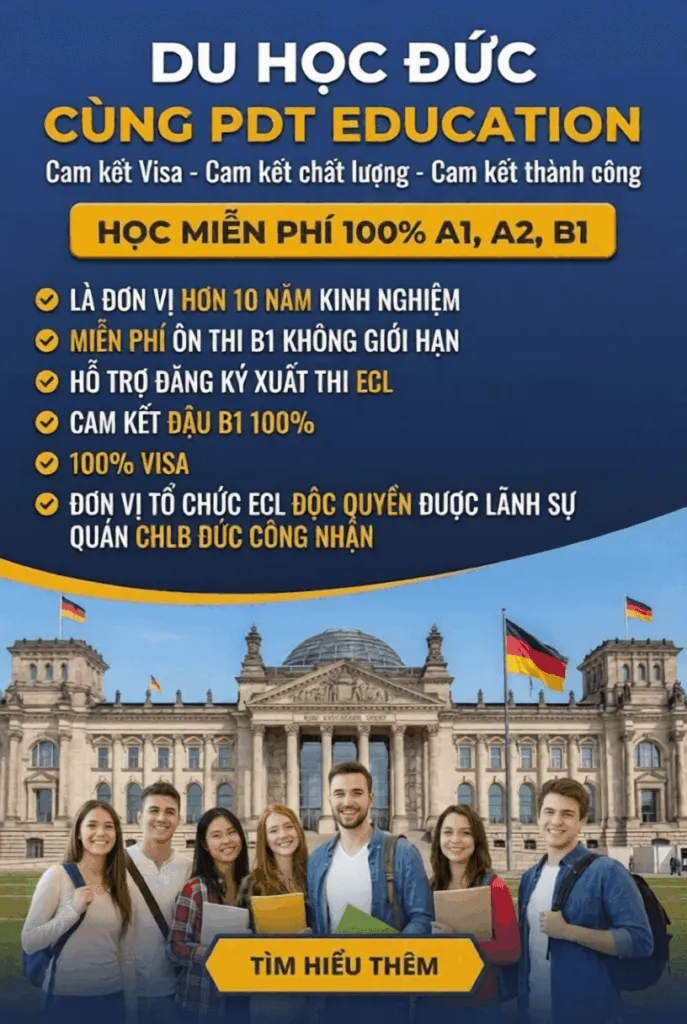
If you are looking for a reliable partner in the process of learning German and building a roadmap to study and work in Germany, PDT Education is a choice trusted by many students. With strengths in formal German training and personalized orientation consulting, PDT Education helps you prepare a solid foundation before entering the degree recognition journey.
Please contact PDT Education for more information and detailed advice to choose the most suitable roadmap for you.