

The Sprechen section of ECL B1 often makes candidates nervous, not because the topics are too difficult, but because they must speak at B1 level, react to their Partner, and maintain the flow of communication under exam-room pressure. To optimize their score, candidates should not memorize a long speech. A more effective approach is to understand the format precisely, practice reusable response phrases, and know how to turn a short answer into a conversation with questions, answers, reasons, and examples. This is the most important foundation of the B1 German speaking exam tips practical experience.
When learning about B1 German speaking exam tips, eCL assesses communicative competence according to CEFR Common European Framework of Reference for Languages. From August 1, 2026, ECL applies a new modular system: Reading, Writing, Listening, and Speaking can be registered by module, and each module must achieve at least 60% to be recognized. For Speaking B1, the duration is about 20 minutes, and candidates usually take the exam in pairs; if there is an odd number of candidates, a group of three may be formed. There is no preparation time before the speaking section.
Overview of the ECL B1 German speaking exam in pairs: Partnerprüfung and what candidates need to know

What is Partnerprüfung B1 ECL? Key differences from other B1 German speaking exams
For the B1 German speaking exam tips program, Partnerprüfung B1 ECL can be understood as a speaking exam format in which two candidates participate in the same exam session. The important point is that a paired exam does not mean the entire Speaking section is a debate between two people. In ECL, the clearest interaction takes place in the Guided Conversation; afterward, candidates must also present based on a picture. Therefore, candidates need two abilities at the same time: maintaining a conversation with their Partner and developing a relatively independent spoken idea.
When preparing B1 German speaking exam tips, unlike the learning method of one model answer for each topic, ECL focuses on the ability to use language in familiar situations. B1 requires learners to be able to talk about everyday issues, express opinions, give reasons, describe experiences, and respond to opinions. This is also why a candidate who uses sentences that are not overly complex but communicates naturally, clearly, and responsively can still demonstrate B1-level ability.
Structure of the B1 paired German speaking exam: Sections and duration
To optimize the effectiveness of B1 German speaking exam tips, according to ECL official guidelines, the Oral Communication section consists of three parts. The introduction lasts about 3–5 minutes to help candidates become familiar with the exam situation and is not graded. The Guided Conversation lasts about 5–8 minutes; the examiner initiates the topic and uses questions to encourage conversation between the candidates. The Picture Description, based on a visual prompt, also lasts about 5–8 minutes; the examiner may provide support with questions when needed. The Speaking B1 module is published as lasting approximately 20 minutes overall.
| Section | Reference duration | Goal | Strategy |
|---|---|---|---|
| Introduction | 3–5 minutes | Getting familiar, reducing tension; not graded | Answer naturally without trying to show off difficult structures |
| Guided Conversation | 5–8 minutes | Discussing a topic and demonstrating interaction | Ask the Partner, respond, give reasons and examples |
| Picture Description | 5–8 minutes | Presenting ideas based on a picture | Brief description, logical inference, connection to experience or opinion |
ECL B1 Sprechen scoring criteria: Fluency, pronunciation, vocabulary, and interaction skills
Based on German-language training experience regarding B1 German speaking exam tips, eCL scores Speaking according to 5 criteria, each worth 0–5 points, for a total of 25 points: morphosyntactic accuracy; oral accuracy including pronunciation, intonation, and fluency; vocabulary; language style appropriate to the context; and communicative effectiveness/task completion. Therefore, speaking a lot is not necessarily the optimal strategy. A long sentence with structural errors, off-topic content, or no response to the Partner is not necessarily more advantageous than a short, clear turn that serves the communicative function correctly.
When learning about B1 German speaking exam tips, candidates should check each speaking turn with four questions: Did I answer the question correctly? Did I give at least one reason? Did I create an opportunity for my Partner to continue speaking? Did I use linking words to turn my answer into a complete idea? This is a way to turn the scoring rubric into concrete behavior in the exam room.
B1 German speaking exam tips for working with your Partner and achieving the highest score

Understanding the Partner's role in the exam room and how to maintain a natural conversation
For the B1 German speaking exam tips program, the partner is not an opponent but a communication support. In the Guided Conversation, the examiner needs to observe your ability to maintain an exchange, so a candidate who only looks at the examiner and answers like in an individual interview will miss the opportunity to demonstrate interaction. After answering, pass the turn with a question such as Und wie siehst du das?, Was meinst du dazu? or Wie ist das bei dir?.
A B1 German speaking exam tips the important thing is to apply the rhythm of opinion – reason – example – question back. For example: I prefer travelling by train because I can rest while on the way. Last year I travelled to Berlin by train and found it very convenient. How do you like to travel best? Just three sentences already demonstrate a choice, a reason, an experience, and interaction.
Strategy for organizing ideas, asking questions, and responding effectively in Partnerprüfung B1 ECL
When preparing B1 German speaking exam tips, candidates do not need to assign rigid roles with their Partner before the exam, but they can practice a flexible coordination mechanism. When the topic appears, the person starting should answer the question directly; the other person responds by agreeing/disagreeing with a reason and then adds a new perspective. After 2–3 turns, the two should move to another aspect of the topic instead of repeating the same idea.
- Step 1 – Stellung nehmen: State a brief opinion: Ich denke, dass…
- Step 2 – Begründen: Explain: weil…, denn…, deshalb…
- Step 3 – Beispiel: Give an example or experience: For example…, In my case, it is like this that…
- Step 4 – Partner aktivieren: Invite the Partner to respond: Wie ist deine Meinung dazu?
To optimize the effectiveness of B1 German speaking exam tips, when practicing, limit each speaking turn to around 20–35 seconds. The goal is not to time yourself mechanically but to avoid two extremes: giving a one-sentence answer or speaking in a monologue for too long and losing the opportunity to interact.
Experience with the paired ECL speaking exam: How to handle a Partner who speaks quickly, forgets an idea, or makes mistakes
Based on German-language training experience regarding B1 German speaking exam tips, in experience with the paired ECL speaking exam, the most difficult situation is often not the question but the Partner. If the Partner speaks too quickly, do not try to interrupt in Vietnamese or remain silent. Use a polite sentence: Could you please say that a little more slowly? or If I understood you correctly, you mean that…?. The second sentence is especially useful because it both confirms the information and demonstrates interaction skills.
When learning about B1 German speaking exam tips, if the Partner forgets an idea, you can save the conversation with an open question: Welche Vorteile siehst du dabei?, Have you already had a similar experience?. If the Partner makes a grammatical mistake, do not correct them directly unless you have misunderstood the content. Your task is to communicate, not to act as a third examiner.
Common mistakes that cause candidates to lose points in the paired B1 German speaking exam
- Memorizing a long speech and trying to steer every question toward the learned speech.
- Only answering the examiner and barely looking at or asking the Partner.
- Using too many sentences beginning with Ich denke… without a reason or example.
- Trying to use overly complex Nebensätze, causing repeated errors in word order.
- Remaining silent for too long when you cannot remember a word instead of paraphrasing with simpler words.
- Interrupting the Partner or taking up most of the speaking time.
- Describing a picture by listing objects without relating them to the topic, actions, or meaning.
For the B1 German speaking exam tips program, the key point is: B1 does not require perfect German. B1 requires you to communicate in a relatively accurate, coherent, and situation-appropriate way. Therefore, prioritize correct sentences with a clear function over difficult sentences that you cannot control well.
B1 German speaking exam phrases for natural communication and scoring well with the examiner

Opening, maintaining, and closing conversation phrases for the ECL B1 speaking exam
When preparing B1 German speaking exam tips, the B1 German speaking exam phrases should be learned by function, not as a fixed script. Once you know 3–5 structures for each function, you can flexibly combine them with many topics.
- Opening: I find the topic interesting because…; Meiner Meinung nach…
- Maintaining: Furthermore, I think that…; Another point is…
- Asking the Partner: What do you think about it?; Hast du damit Erfahrung?
- Changing the topic: On the other hand…; As far as … is concerned, …
- Concluding: In summary, I would say that…; For me, … would therefore be the better solution.
Redemittel for discussing opinions, agreeing, disagreeing, and making suggestions with the Partner
| Function | Suggested Redemittel | How to Use |
|---|---|---|
| Expressing an opinion | I am of the opinion that… / I believe that… | Used to open a point of view |
| Agreeing | I agree with you. / I see it the same way. | Do not stop at agreement; add a reason |
| Partially agreeing | You are partly right, but… | Helps express disagreement softly |
| Disagreeing | I see it a little differently because… | Avoid overly direct negation |
| Making a suggestion | We could… / How about if…? | Useful for planning topics |
| Priority | I would rather…, because… | Expresses a choice with a reason |
Rescue phrases when you have no ideas or do not understand the question in the exam room
To optimize the effectiveness of B1 German speaking exam tips, being stuck for an idea is less frightening than remaining silent. Prepare a group of rescue phrases to buy a few extra seconds for thinking while maintaining communication:
- Could you please repeat the question? – Ask the examiner to repeat the question.
- If I understood the question correctly, it is about…? – Confirm your understanding.
- I have not thought much about that yet, but I would say that… – When you have not thought deeply about the topic before.
- I cannot think of the exact word right now, but I mean… – When you forget a word.
- I can give an example from my everyday life. – Shift to an everyday-life example.
Based on German-language training experience regarding B1 German speaking exam tips, rescue phrases should not be overused. Using one appropriately shows the ability to handle a situation; repeating them too often can interrupt the flow of speech.
How to use German B1 linking words to make your speech more coherent and more developed
When learning about B1 German speaking exam tips, linking words are the backbone of a B1 answer. Instead of connecting every sentence with und, actively use weil to give a reason, deshalb for a result, aber for contrast, außerdem to add information, zum Beispiel for an example, and trotzdem to express contrast.
For the B1 German speaking exam tips program, an effective practice structure is: Opinion + because + example + therefore. Example: I like doing sports because I have less stress afterwards. For example, I go jogging three times a week. Therefore, I try to find time for it even on working days. An answer like this is coherent enough without exceeding what a B1 learner can control.
How to practice German B1 speaking effectively before the ECL exam with a practical roadmap
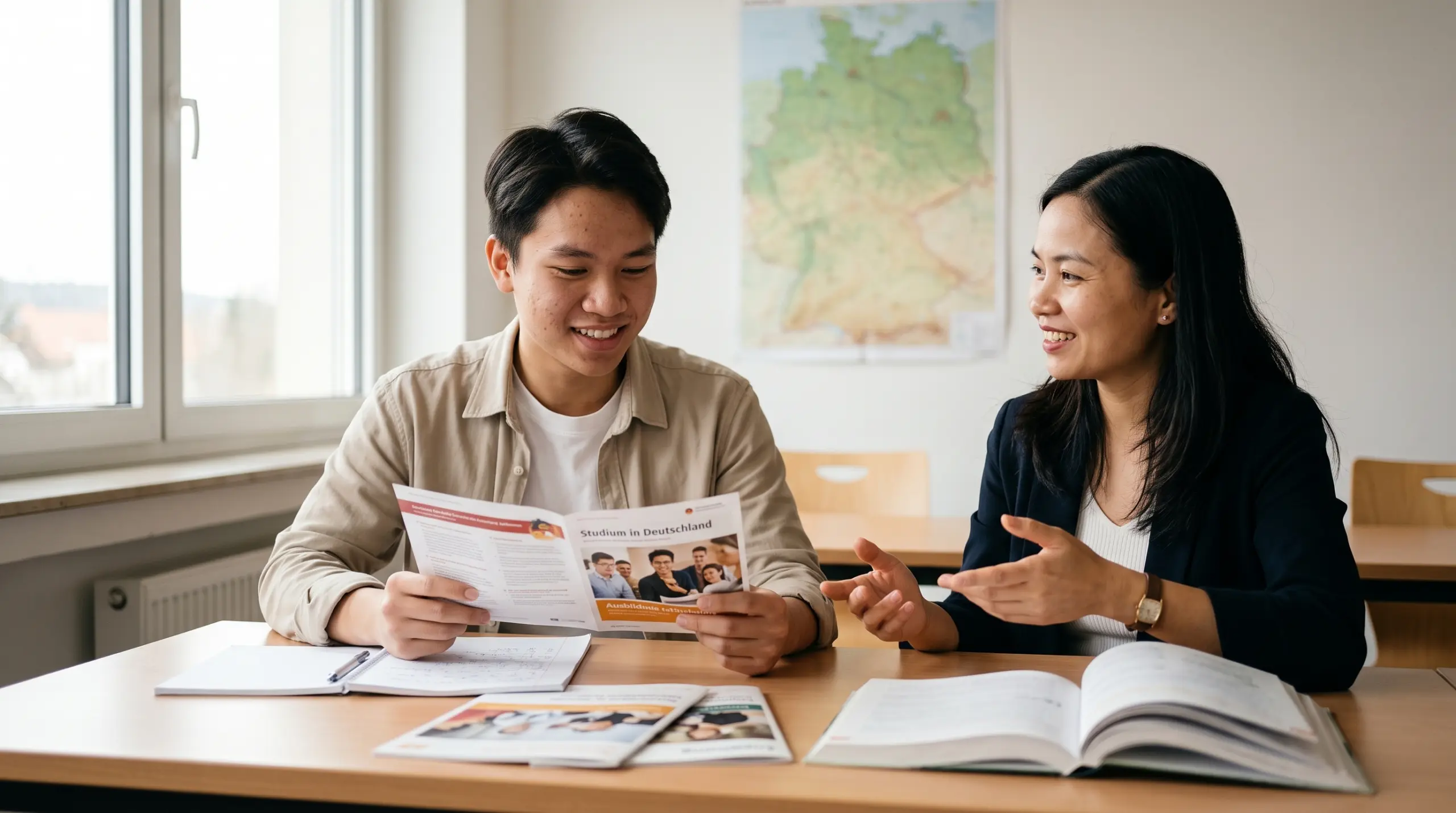
Practice German speaking responses every day instead of memorizing mechanical answers
Speaking fluency does not develop through silent reading. Every day, choose a B1 topic and speak aloud for 2–3 minutes, then answer 5 related open questions. When practicing B1 German speaking exam tips, create a sufficient vocabulary limit: 10–15 keywords, 5 linking words, and 5 Redemittel. Learning less but being able to use it immediately is more valuable than learning a list of 100 words that do not come out when speaking.
When preparing B1 German speaking exam tips, if you are following B1 German language course, require each speaking practice session to have a clear criterion: practice fluency today, response questions tomorrow, and Picture Description the next day. Do not simply speak more without knowing which criterion you are improving.
Paired speaking practice method that accurately simulates the Partnerprüfung B1 ECL format
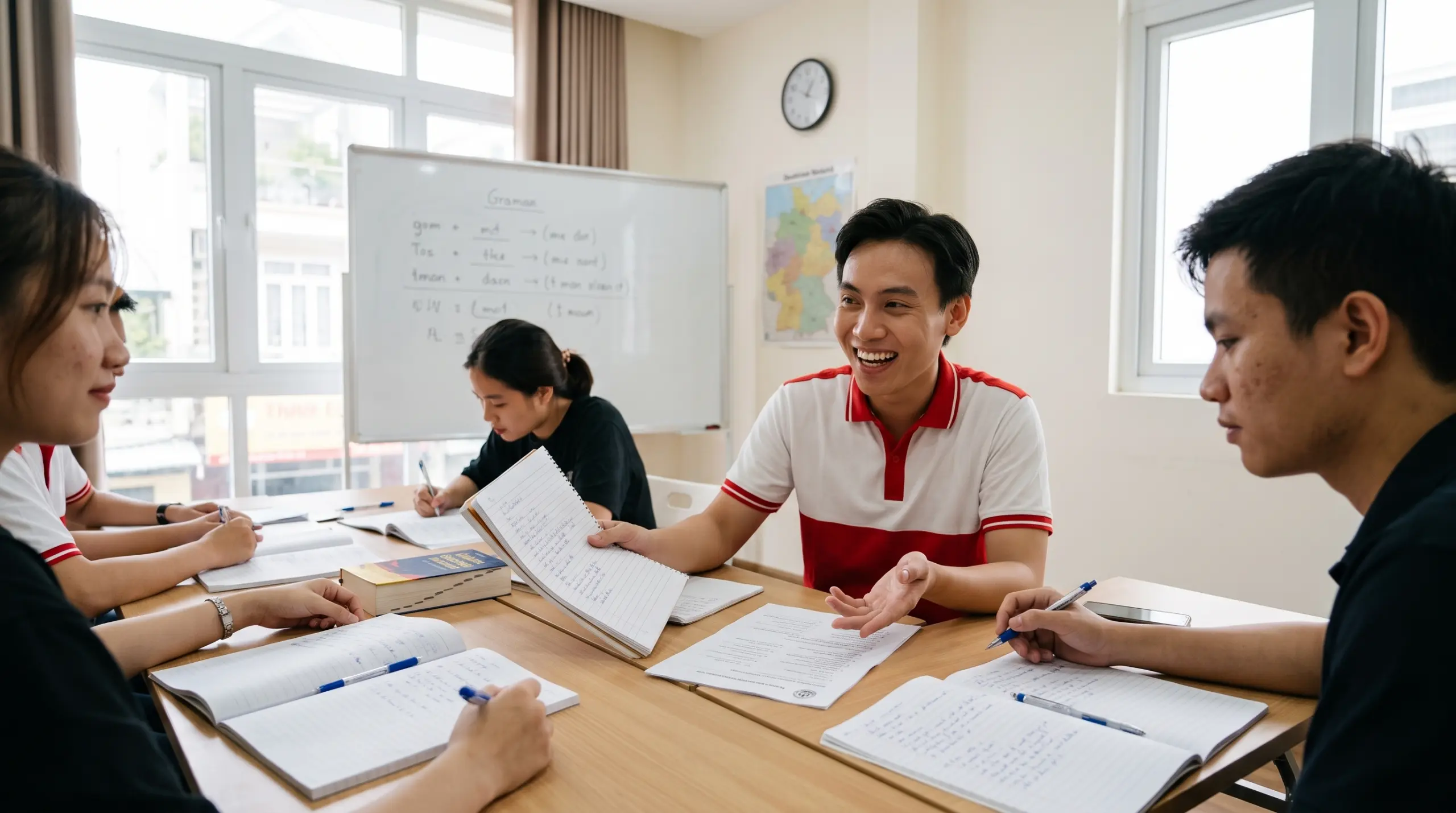
A mock test should simulate actual exam pressure: no preparation beforehand, use a timer, have a third person act as the examiner, and do not stop to correct mistakes halfway through. Only after the exam should the two Partners review their mistakes. ECL currently states that the Speaking section has no preparation time and is usually conducted in pairs; therefore, practicing a topic for too long before starting can create a feeling of false competence while real-time response remains weak.
A good practice method is to change Partners periodically. A familiar Partner helps build confidence, but in the real exam you may encounter someone with a different speed, accent, vocabulary, and interaction style. Once you become accustomed to adapting to 3–4 types of Partners, you will be less likely to be thrown off.
Combine pronunciation practice, recording, and self-assessment to improve Sprechen skills
Record a 3-minute speech and score it using 5 columns similar to the ECL rubric: grammar, pronunciation – fluency, vocabulary, style, and communicative effectiveness. Each time, choose only 1–2 high-impact errors to correct. For example, if your pronunciation is clear but you stop after every 4–5 words, prioritize fluency first; if you speak fluently but repeat gut, schön, interessant, expand your topic-based groups of adjectives and verbs.
A useful technique is to listen again and mark pauses longer than 2 seconds. Then write down Redemittel that can replace those moments of silence. Doing this consistently for 7–10 days will give you bridges to use when your brain needs time to find a word.
7-day ECL B1 revision strategy to build confidence
| Day | Focus | Main exercise | Goal |
|---|---|---|---|
| Day 1 | Format + rubric | Complete 1 full mock test | Identify the 3 biggest mistakes |
| Day 2 | Redemittel | Practice expressing opinions, agreeing, disagreeing | Respond without translating |
| Day 3 | Partner interaction | 10 mini-dialogues, 3 minutes per topic | Natural questions and answers |
| Day 4 | Picture Description | 6 picture sets, 2 minutes each | Description + inference + connection |
| Day 5 | Pronunciation + fluency | Recording and shadowing | Reduce hesitation |
| Day 6 | Pressure mock test | Practice with a different Partner | Adapt to the situation |
| Day 7 | Light review | Review linking words, get enough sleep, do not cram new material | Mental stability |
Common topics in the paired B1 German speaking exam and how to prepare ideas
Topic Alltag und Freizeit: Hobbies, free time, and everyday activities
ECL B1 focuses strongly on familiar areas of life such as personal matters, family, housing, communication, entertainment, sports, hobbies, education, and work. The official topic list also includes hobby, sport, culture/entertainment, and daily routine.
For Alltag und Freizeit, prepare 5 idea blocks: what you do, how often, with whom, why you like it, and benefits/difficulties. For example, the topic Freizeit can be expanded into Sport, Freunde, Internet, Musik, or Wochenende without having to learn an entirely new answer.
Topic Reisen und Urlaub: Travel, transport choices, and holiday planning
For Reisen und Urlaub, candidates should have vocabulary ready for Verkehrsmittel, Fahrkarte, Unterkunft, Reiseplanung, Vor- und Nachteile. When asked to choose between Zug and Auto, do not just say Ich fahre mit dem Zug. Add criteria such as cost, time, environment, comfort, and flexibility.
Easy-to-use formula: I would choose … because… One advantage is… However… Therefore…. This formula gives the answer both advantages and disadvantages, making it more suitable for B1 than a choice without reasoning.
Topic Arbeit und Ausbildung: Work, study, and career orientation in Germany
Studying/Work is included in the official ECL B1 topic list. Learners can prepare ideas about preferred professions, work environment, working hours, colleagues, necessary skills, and vocational training plans.
If your goal after B1 is Ausbildung, use speaking practice to learn real vocational vocabulary. However, clearly distinguish this: a B1 certificate is evidence of language ability, not a guarantee of a visa. According to visa regulations of the German Embassy for Ausbildung in Vietnam, current applications require at least B1 and list ECL alongside Goethe, telc, ÖSD, and TestDaF among accepted certificates; language certificates submitted with applications must currently be no more than 12 months old at the time of submission.
Topic Familie und Zusammenleben: Family, friends, and familiar social issues
For Familie und Zusammenleben, avoid giving overly personal answers if you are uncomfortable. You can speak generally about dividing household chores, time spent with family, multigenerational living, relationships with friends or neighbors. ECL assesses language ability rather than whether an opinion is correct.
To give the answer greater B1 depth, add a contrast pair: Einerseits… andererseits…. Example: living with family can save money and provide mutual support, but it can also mean having less private space. This is a way to create sufficiently rich content without requiring academic vocabulary.
PDT Education supports ECL B1 exam preparation and the journey toward Germany
CEFR-standard German training from A1 to B2, developing all 4 skills
With more than 10 years of international education experience according to the information provided by the brand, PDT Education designs a German-learning pathway that does not stop at simply passing B1. Students need to develop listening, speaking, reading, writing, and the ability to use German in daily life, vocational training, interviews, and the workplace. For those looking for B1 German language course, selection criteria should include learning outcomes, hours of speaking practice, mock-test frequency, error correction methods, and the degree of personalization according to application goals.
| Stage | Proficiency goal | Priority focus |
|---|---|---|
| A1 | Basic communication in familiar situations | Pronunciation, simple sentences, foundational vocabulary |
| A2 | Expanding everyday communication | Question-and-answer responses, describing activities and simple experiences |
| B1 | Speaking coherently about familiar topics, giving reasons and opinions | Redemittel, linking words, Partner interaction, exam practice |
| B2 | More independent communication in study and professional settings | Argumentation, vocational vocabulary, listening at natural speed |
ECL/Goethe certificate exam preparation with teachers and a personalized learning pathway
The ECL/Goethe exam preparation program should aim for a high certificate pass rate through actual competence, rather than turning the pass rate into a guarantee. A good pathway should include an entrance assessment, goals for each skill, regular mock tests, and each learner's individual error data.
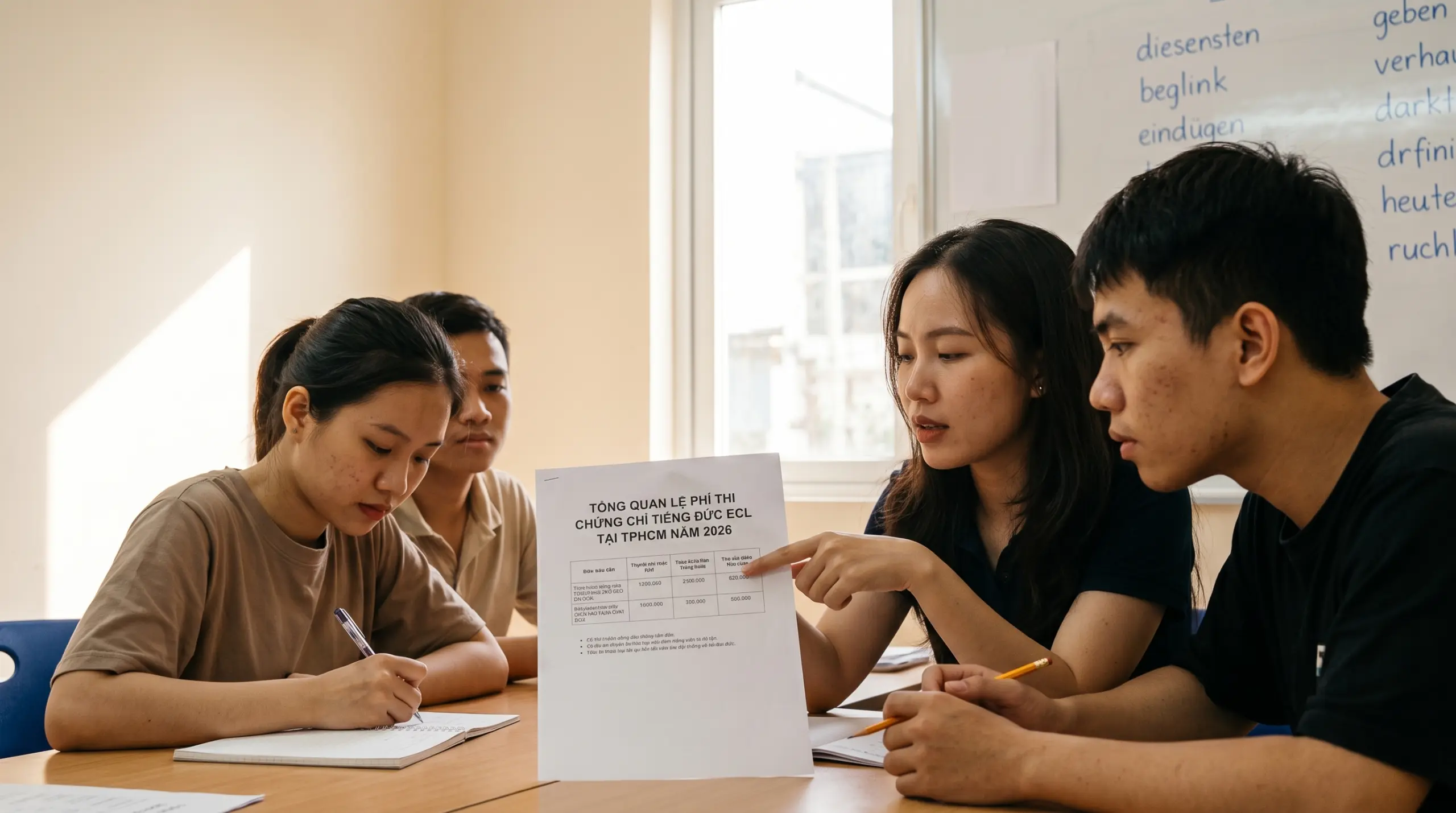
Regarding fees, learners should check the specific exam session because fees may change. The PDT website currently publishes a 2026 ECL B1 Complex fee of 5,500,000 VND; Goethe-Institut Vietnam publishes 5,000,000 VND for the Goethe-Zertifikat B1 for independent candidates in Hanoi/Ho Chi Minh City for 4 modules and 1,500,000 VND for one module. For telc, fees are published by each authorized examination center, so confirmation should be obtained from the registration location rather than using a single global rate.
| B1 Exam | Reference exam fees in Vietnam 2026 | Notes |
|---|---|---|
| ECL B1 | 5,500,000 VND for the Complex package at the rate currently published by PDT | From August 1, 2026, ECL has switched to a modular system; reconfirm the price for each module/exam session before registering |
| Goethe-Zertifikat B1 | 5,000,000 VND/4 modules for independent candidates; 1,500,000 VND/module | 2026 rate published by Goethe-Institut Vietnam; internal students have different rates |
| telc Deutsch B1 | Depends on the authorized examination center | Check the schedule and fee directly with the examination location at the time of registration |
Transparent German vocational study orientation for Nursing, Hospitality, and Mechanical Engineering
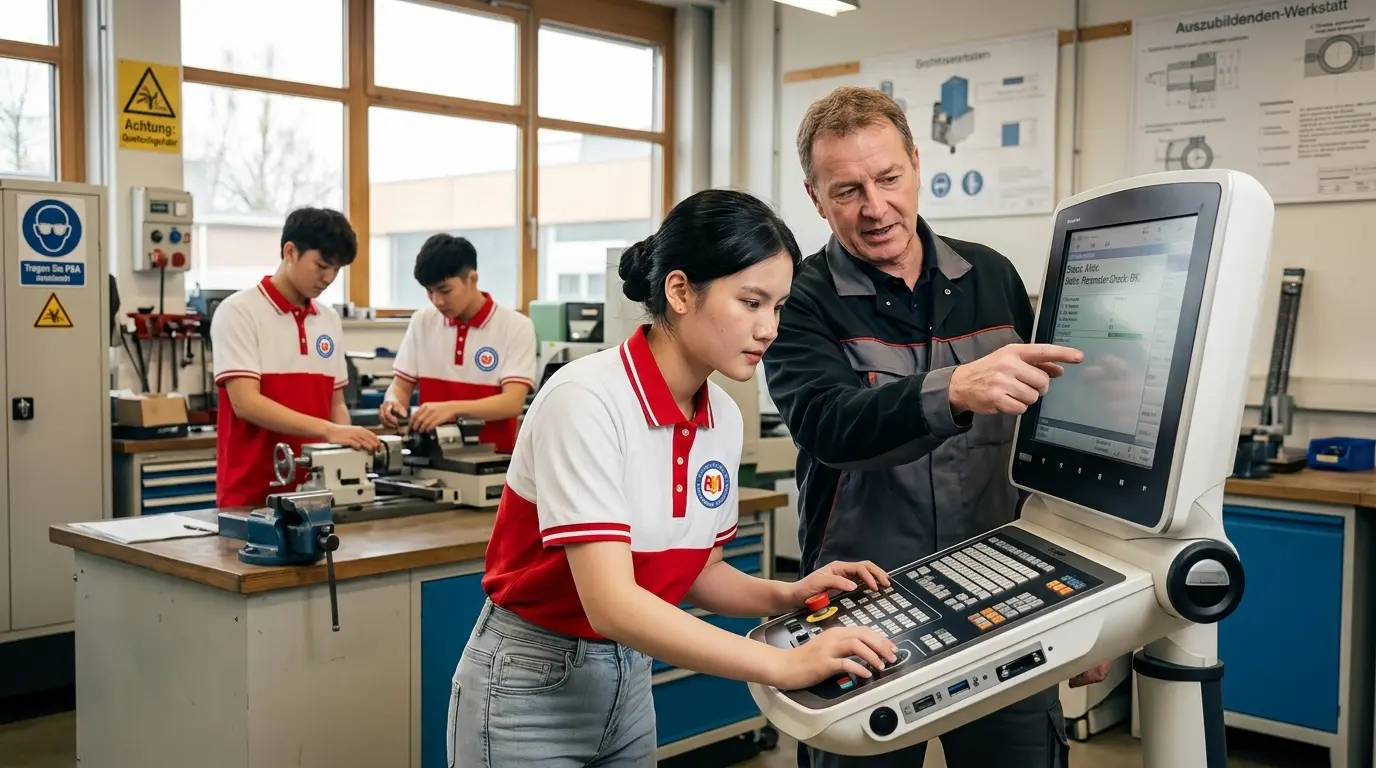
For students aiming for Ausbildung, the consultation pathway should connect German language learning with fields such as Nursing, Hospitality, and Mechanical Engineering, while also being documented through a transparent vocational study contract. A point that should be made clear from the outset is not all vocational training programs in Germany have the same tuition fees, allowance levels, or entry requirements. Company-based Ausbildung generally includes Ausbildungsvergütung; school-based programs may have a different financial structure.
The phrase “100% tuition-free” should be understood according to each contract and training model. In many dual Ausbildung programs at companies, students do not pay vocational training tuition to the company and receive an allowance; however, this should not be generalized to mean that every program in Germany is free. An allowance of around 1,000–1,400 EUR/month may occur in some positions/programs, but the actual amount depends on the occupation, training year, federal state, and Ausbildungsvertrag. Published allowance ranges can differ by program, so students should read the specific contract before signing.
| Category | Principle to understand | Points to check |
|---|---|---|
| Ausbildung tuition | Many dual company-based training programs do not charge vocational tuition | Does not automatically apply to every school/program |
| Vocational Training Stipend | May be around 1,000–1,400 EUR/month in some contracts | Check gross/net, training year, and contract terms |
| Sperrkonto | Not automatically required for every Ausbildung application with a company | May need to be supplemented if the allowance is insufficient to cover living expenses |
| Costs in Vietnam | Language study, certificate exams, translation, notarization, documents, airfare… | A transparent fee table is needed by service and contract |
Support with document preparation, visa applications, Sperrkonto financial proof, and guidance under the Fachkräfteeinwanderungsgesetz
For an Ausbildung visa under §16a Aufenthaltsgesetz, the official Make it in Germany portal states that applicants need a specific training position, appropriate German-language skills, and secured living expenses. In 2026, for company-based training, an Ausbildungsvergütung of 1,048 EUR gross or 822 EUR net per month is considered sufficient to secure living expenses; if it is lower, the shortfall can be covered through a Sperrkonto or Verpflichtungserklärung. For school-based training, the reference amount is 959 EUR net per month.
This also means Sperrkonto is not a default requirement for every vocational study applicant. The type of Ausbildung and the allowance stated in the contract must be considered. In Vietnam, Ausbildung visa applications are currently submitted through the online portal and VFS according to the guidance of the German mission. APS is also not a default step for Ausbildung applications: APS in Vietnam primarily verifies university admission eligibility and academic achievements of Vietnamese applicants intending to study at university in Germany.
German Skilled Immigration Act – Skilled Immigration Act – has expanded and adjusted various pathways for qualified workers and people with professional experience. However, learners need to distinguish between vocational training in Germany under the Ausbildung route and going to Germany to work as a skilled worker after meeting the corresponding requirements. The name of the law should not be used as a guarantee that every application will receive a visa.
In practical application consulting, a reliable pathway should connect 4 parts: genuine German-language ability, an appropriate certificate, a transparent Ausbildung contract, and a visa application under the correct category. When these four parts are prepared together, students can reduce the risk of having to revise documents, retake exams, or incur unplanned costs.
Conclusion: To optimize your score in the paired B1 German speaking exam, focus on three core abilities: expressing ideas clearly, genuinely interacting with the Partner, and controlling B1-level structures within your ability. Do not memorize a perfect speech; build a toolkit consisting of Redemittel, linking words, rescue phrases, and an idea-development framework that can be used for many topics. If you need an assessment of your current level, an ECL B1 practice pathway, or a connection between your German-learning plan and an Ausbildung application, PDT Education can support you from the learning and certificate-exam stage through preparation for your journey to Germany according to your specific circumstances.