

When researching retaking the German certificate examination, failing one skill in the ECL examination no longer means that candidates must retake all four skills. From August 1, 2026, ECL officially applies a modular examination structure: Reading, Writing, Listening, and Speaking are treated as four independent modules, with each module requiring at least 60% to be recognized. This is an especially important change for people researching retaking the examination German language certificate, because passed results can be retained and candidates only need to register for the skills they are still missing.
For the German certificate retake program, however, the new mechanism does not apply retroactively to examinations taken before August 2026. At the same time, holding an ECL certificate does not automatically mean that every application for study abroad, Ausbildung, or employment has the same requirements. Learners need to distinguish ECL examination regulations from the certificate acceptance requirements of vocational schools, companies, and visa authorities. The article below updates ECL retake regulations, result retention, retaking the Writing skill, score review, and how to build an appropriate roadmap for German learners in 2026.
Retaking the ECL German Certificate: When Do You Need to Retake Individual Skills?

Overview of the regulations for retaking the ECL German certificate after not achieving the desired result
During preparation to retake the German certificate examination, the first point to remember is the date 01/08/2026. For examinations held from this point onward, ECL applies a modular examination model. Candidates may register for the Complex examination covering Reading, Writing, Listening, and Speaking, or register separately for one or more modules as needed. Each module is scored independently and is considered passed when the candidate achieves at least 60% of the total score for that module.
For example, a candidate taking ECL B1 Complex scores 68% in Reading, 52% in Writing, 72% in Listening, and 64% in Speaking. Under the regulations applicable from August 2026, Reading, Listening, and Speaking have been passed; the candidate only needs to retake Writing. This is the major advantage of the new mechanism for people who need to retake the German certificate: they do not have to spend time and pay fees to retake skills that have already met the standard.
To optimize the effectiveness of retaking the German certificate examination, conversely, results from examinations before August 2026 are processed under the old regulations. At that time, ECL assessed candidates through the Complex examination or two skill groups, Written and Oral, with a minimum of 40% for each skill and an average score according to the regulations. A skill scoring above 60% in the old examination but belonging to a failed examination component cannot be retroactively converted into a passed module under the new regulations.
Cases where individual Listening, Speaking, Reading, and Writing skills may be retaken in the ECL examination
Based on German-language training experience regarding retaking the German certificate examination, for examinations from August 2026, ECL allows candidates to register for individual modules or combine multiple modules. Therefore, if some skills have already been passed and others are still missing, candidates can register specifically for the parts that need improvement.
- Retake Reading: when the Reading result is below 60%.
- Retake Writing: when the Writing result is below 60%; other passed modules do not need to be retaken.
- Retake Listening: when Listening is below 60%.
- Retake Speaking: when Speaking is below 60%.
- Retake multiple skills: you can register for a combination of modules that were not passed in the next examination session.
When researching retaking the German certificate examination, this regulation also means that using strong skills to compensate for weak skills is no longer applicable to ECL from August 2026. To complete all four modules, each individual skill must meet the 60% threshold.
Registration period and important considerations before retaking the German certificate examination
For the German certificate retake program, according to general ECL guidance, the usual registration deadline is approximately four weeks before the examination date; late registration may be allowed depending on the examination session and may incur an additional fee. Fees are determined at each examination center, so candidates must check the center's notice at the time of registration rather than using an old fee schedule.
During preparation to retake the German certificate examination, before registering for a retake, you should check three dates: the examination date, the expected result publication date, and the certificate deadline. ECL publishes results within 30 days of the written examination. For people preparing for Ausbildung or a visa, this buffer period is important because the language certificate is only one part of the entire application.
To optimize the effectiveness of retaking the German certificate examination, learners can research ECL exam registration in HCMC along with an appropriate review schedule before deciding to retake the examination. In particular, do not immediately register for the nearest available session simply because you want the certificate quickly if mock examination results show that the skill has not yet been consistently above the required threshold.
ECL Retake Regulations and German Certificate Result Retention You Need to Know

The mechanism for retaining ECL German examination results by individual skill that meets the requirements
Based on German-language training experience regarding retaking the German certificate examination, the term ‘result retention’ is commonly used by learners to describe keeping a skill that has already been passed. Under the official regulations applicable from August 2026, if a candidate achieves 60% or more in one or more modules, ECL issues certification for the modules successfully completed. The candidate does not have to retake these modules simply because another skill was not passed.
When researching retaking the German certificate examination, the more important point is the one-year validity period. If all four modules are successfully completed within one year, calculated from the examination date, the candidate can request issuance of a combined certificate recording all four modules and their respective examination dates. This is ECL's official mechanism from August 2026 and does not apply to examination results from before this date.
Conditions for combining skill scores from different examination sessions
For the German certificate retake program, candidates need to distinguish between ‘adding scores’ and ‘combining passed modules’. ECL does not add the score of a weak skill to a strong skill to create a passing average. Each module must independently achieve at least 60%. When modules are passed in different examination sessions but completed within a one-year period, candidates can request a combined certificate under the current regulations.
During preparation to retake the German certificate examination, for example: in September 2026, Reading and Listening are passed; in November 2026, Writing is passed; in February 2027, Speaking is passed. If the examination sessions remain within one year calculated by examination date and all modules achieve at least 60%, the candidate can complete the procedure to request a combined certificate according to ECL regulations.
To optimize the effectiveness of retaking the German certificate examination, results obtained before August 2026 cannot be converted into modules under the new system and combined with results obtained after August 2026. This is a point that candidates who took ECL during the first half of 2026 need to check particularly carefully.
The difference between retaking the entire examination and retaking one ECL skill
| Criteria | Complex 4-skills exam | Retaking individual skills from 08/2026 |
|---|---|---|
| Scope | Reading, Writing, Listening, Speaking | Only the module that needs to be retaken |
| Passing Threshold | Each module at least 60% | Examined module at least 60% |
| Passed result | Recorded by module | No need to retake a passed module |
| Cost | Higher than taking one module | Calculated by individual skill at the examination center |
| Suitability | First-time candidates or those who want to take all four skills in the same session | Candidates who are still missing one or more skills |
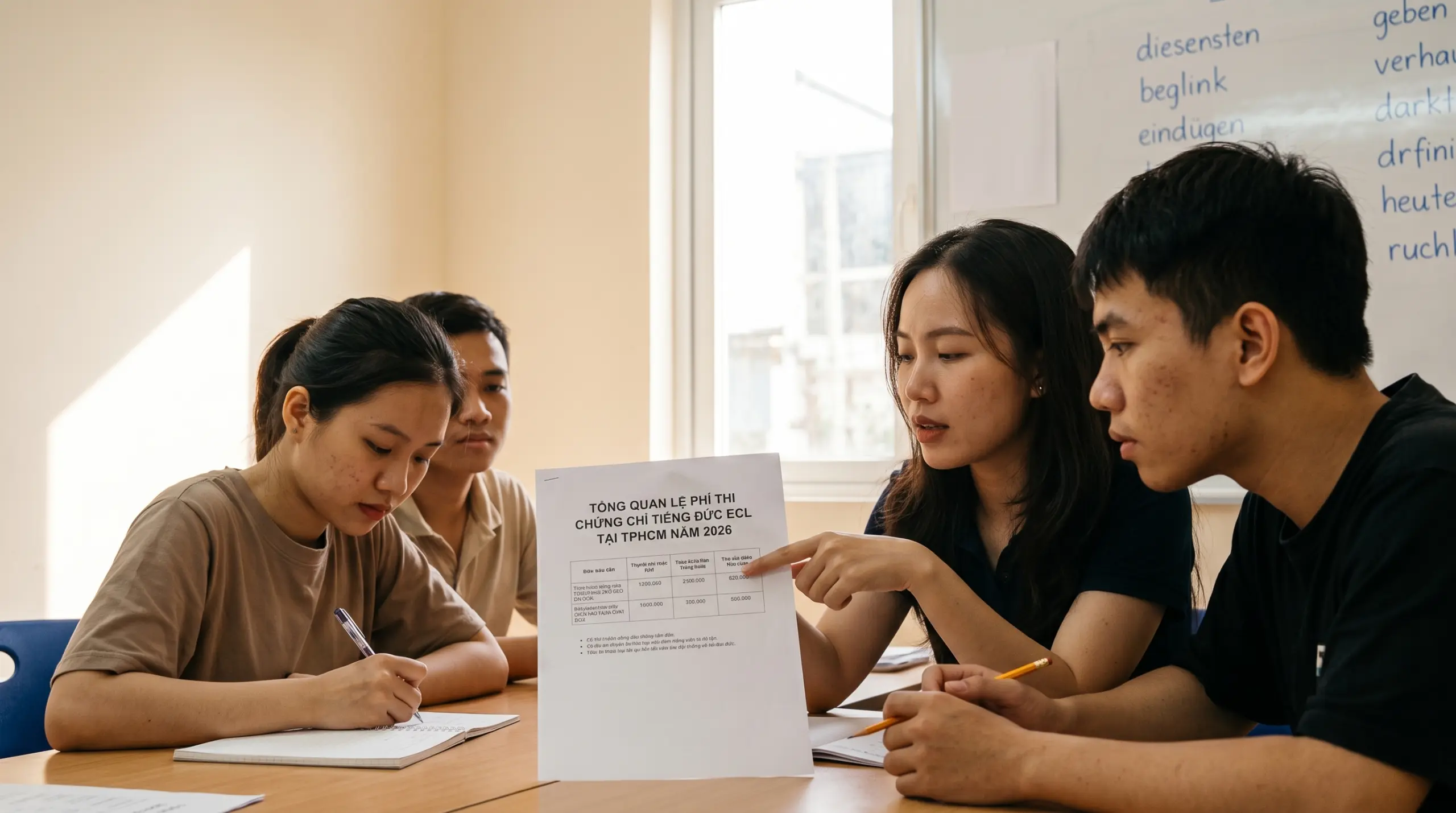
Based on German-language training experience regarding retaking the German certificate examination, according to the PDT Education fee schedule updated under the fee schedule applicable in Vietnam from 04/06/2026, the current reference rates are: A2 Complex 5,500,000 VND and 1,600,000 VND/skill; B1 Complex 6,000,000 VND and 1,700,000 VND/skill; B2 Complex 6,500,000 VND and 1,800,000 VND/skill. Actual fees need to be reconfirmed at the time of registration because ECL stipulates that fees are determined by the examination center.
| Level | Complex 4 skills | Taking 1 skill separately |
|---|---|---|
| A2 | 5,500,000 VND | 1,600,000 VND |
| B1 | 6,000,000 VND | 1.700.000 VND |
| B2 | 6.500.000 VND | 1,800,000 VND |
Retaking the ECL Writing Skill: Process, Experience, and Ways to Improve Scores

Why does the ECL Writing skill often make candidates need to retake the examination?
Retaking the ECL Writing skill is not simply a matter of grammatical errors. ECL assesses Writing from multiple dimensions: morphology and syntax, text structure and spelling, vocabulary, language style, and communicative effectiveness. Therefore, a text with few grammatical errors can still lose points if it does not fully address the task requirements, uses an inappropriate register, or organizes ideas incoherently.
Common errors include writing at length while omitting required points, spending too much time on the first task, using memorized templates that do not fit the situation, using complex vocabulary incorrectly in context, lacking connections between paragraphs, or failing to distinguish informal and semi-formal styles.
ECL Writing examination structure and assessment criteria you need to master
At ECL German B1, the Schriftliche Kommunikation section lasts 40 minutes, approximately 200 words, equivalent to approximately 100 words for each task. Candidates generally have to handle one text in an informal register and one text in a semi-formal register, such as an email, forum post, note, or announcement. Candidates are permitted to use a printed monolingual or bilingual dictionary in the Writing section according to ECL regulations.
Each writing task is assessed according to five groups of criteria, each scored from 0 to 5 points: Formale Korrektheit for morphology and syntax; Schriftliche Korrektheit for text structure and spelling; Vocabulary for vocabulary range and usability; Stil for pragmatic and sociolinguistic appropriateness; and Kommunikative Effektivität for the degree to which the task is completed.
Therefore, test preparation should not focus only on asking ‘how many grammatical errors does this text contain’. The more appropriate questions are: does the text fully answer the requirements, is the structure clear, does the reader correctly understand the communicative purpose, is the register appropriate, and do language errors affect the ability to communicate?.
Effective methods for preparing to retake the ECL Writing skill according to CEFR standards
To improve Writing, start with the score sheet and identify errors according to the five official assessment criteria. If the issue lies in Wortschatz, the solution is to build topic-based phrases and collocations; if it lies in Formale Korrektheit, focus on commonly used B1 structures such as Nebensätze, Relativsätze, Konjunktiv II, conjunctions, and word order; if Kommunikative Effektivität is weak, practice reading the task and creating an outline before writing.
- Practice both tasks within the exact 40-minute limit instead of writing without a time limit.
- Analyze all communication requirements before writing.
- Use sentence structures that are within your ability but accurate instead of trying to create overly complex sentences.
- Use the final minutes to check verbs, verb position, Artikel, Kasus, spelling, and punctuation.
- Grade the writing according to the five ECL criteria rather than only correcting grammatical errors.
- Take multiple mock examinations and only register for a retake when Writing results are consistently above 60%.
Based on training experience at PDT Education, the goal of review preparation should not be merely to narrowly exceed the threshold. A skill that regularly fluctuates around 55–62% still carries significant risk when entering the actual examination. The roadmap ECL exam registration in HCMC should be combined with timed mock examinations and detailed feedback according to each criterion.
ECL Examination Score Review and What Candidates Need to Know

ECL examination score review regulations and steps for requesting a reassessment of the result
Under the current ECL regulations, candidates have the right to request a review or re-evaluation within 15 days from the publication of the results. The request is submitted through the local examination center using the Request for Review/Re-evaluation form. The head of the Examination Centre makes a decision with a professional explanation within 30 days, and the result may be adjusted following the review process.
ECL distinguishes between reviewing issues related to regulations and score calculation and requesting a reassessment of the examination component by another examiner. Therefore, before submitting an ECL examination score review, candidates should read the correct type of request on the form and check the applicable fee at the time of submission.
Candidates also have the right to register to view their examination at the International ECL Examination Centre in Pécs, Hungary, according to the regulations. The scope may include the examination paper, answer sheet, assessment criteria, and the Speaking monologue recording; copying or recording the materials is not permitted.
When should you choose a review instead of registering to retake the German certificate examination?
A review is appropriate when there is a specific basis for believing that the result should be checked again, such as suspected score-calculation errors or a Writing/Speaking result that differs significantly from the ability consistently demonstrated before the examination. A review should not be considered the default option simply because a few points are missing.
If the result is significantly below 60%, retaking the examination after a period of improvement is usually an option that should be prepared in parallel. Conversely, if the score is very close to the threshold and a teacher has a professional basis for believing that the work meets the criteria better than the published result indicates, the candidate may consider the review/re-evaluation procedure within the 15-day deadline.
Factors to consider regarding time, costs, and study plans after a review
People preparing vocational-study-abroad applications need to place the review decision within the overall timeline. ECL may take up to 30 days to decide on a review/re-evaluation request. If the application deadline is approaching, simply waiting for the review without continuing skill practice may cause the loss of another examination session.
A reasonable risk-management approach is to continue studying while waiting for the result. If the review is successful, the retake plan can be adjusted; if the result remains unchanged, the learner has still not lost a month of practice.
Preparation Roadmap for Retaking the ECL German Certificate with PDT Education
Assessing current proficiency and building a plan to strengthen each German skill
Effective retaking must begin with correctly diagnosing the cause. A learner with Reading 72%, Listening 70%, Speaking 65%, but Writing 48% does not need to relearn the entire B1 in the same way as someone with all four skills below the standard. PDT Education focuses on assessing each skill, identifying the gap from the standard, and building a plan based on the time remaining before the examination.
| Stage | Goal | Key focus | Checkpoint |
|---|---|---|---|
| Week 1 | Diagnosis | Take a mock examination for the skill to be retaken and analyze errors | Identify the main error groups |
| Weeks 2–3 | Consolidation | Grammar, vocabulary, and task-handling techniques | Exercises based on ECL criteria |
| Weeks 4–5 | Practice tests | Complete tasks under real-time conditions | Stabilize above the target threshold |
| Final week | Simulation | Take a mock examination and correct final errors | Check readiness level |
The practical roadmap may be longer or shorter depending on initial proficiency. Learners should not interpret the table above as a commitment that every case can improve sufficiently within a few weeks.
CEFR-standard ECL/Goethe preparation programs to optimize the chances of obtaining the certificate
ECL, Goethe, and telc all assess German language proficiency according to the CEFR framework, but their examination structures, durations, task types, and certificate-issuing mechanisms are not completely identical. Therefore, effective preparation must progress from actual German proficiency to strategies appropriate for the correct format, rather than memorizing a set of model answers.
The Common European Framework of Reference for Languages CEFR is a framework used to describe language proficiency levels; ECL currently organizes A2, B1, B2, and C1 levels in accordance with this framework.
With the professional direction developed by Teacher Phan Dinh Thu, PDT Education focuses on two parallel goals: helping learners meet certificate requirements and developing the ability to use German in vocational training, business, and everyday life in Germany. This is particularly important because passing the B1 examination does not mean that the learner has completed the process of developing language proficiency.
Guidance on choosing the appropriate certificate for German vocational study abroad and career development goals
For Vietnamese citizens applying for a visa to undertake vocational training in Germany, the official website of the representative authority of the Federal Republic of Germany in Vietnam currently requires at least B1 German in ordinary cases and lists Goethe-Institut, telc, ÖSD, TestDaF, and ECL Examination Centre among the certificate providers accepted. A language certificate submitted with a visa application must currently be no more than 12 months old, except in cases where an exception is explicitly stated by the representative authority.
Therefore, when applying visa regulations of the German Embassy, learners need to verify the information at the time of application, rather than relying only on articles or old advice. For company-based Ausbildung, B1 is generally the basic visa requirement; companies, Berufsschulen, or certain occupations may set higher requirements.
It is also necessary to distinguish Ausbildung from university study abroad. APS is not a default requirement in the current vocational-training visa document list of the German representative authority in Vietnam; APS primarily appears in procedures related to university study. Ausbildung applications focus on the training contract, confirmation from the vocational school or IHK/HWK where applicable, proof of financial means, German certificate, insurance, and documents required by the visa authority.
Similarly, a blocked account Sperrkonto is not always mandatory for company-based Ausbildung. Under the amount applicable in 2026, for company-based vocational training, an Ausbildungsvergütung of EUR 1,048 gross or EUR 822 net per month can meet the livelihood security requirement; if it is lower, the shortfall may need to be covered by a Sperrkonto or Verpflichtungserklärung. For school-based vocational training, the financial-proof principle is different, and the 2026 reference amount is EUR 959 net per month.
Regulations on vocational training and international employment also fall within the framework of German residence, labor, and skilled-immigration laws, often referred to as the Fachkräfteeinwanderungsgesetz. However, learners need to identify their exact visa category and legal basis; an Ausbildung visa is generally associated with §16a AufenthG, and all vocational training, skilled employment, and qualification-recognition categories should not be treated as a single process.
| Category | 2026 reference level/principle | Note |
|---|---|---|
| Vocational Training Tuition | Many dual company-based Ausbildung programs do not charge vocational tuition fees | Not universally applicable to every private school or school-based programme |
| Vocational Training Stipend | Some PDT programs advertise approximately EUR 1,000–1,400/month | The actual amount depends on the occupation, training year, and Ausbildungsvertrag |
| Financial threshold for company-based Ausbildung | EUR 1,048 gross or EUR 822 net/month in 2026 | If lower, the shortfall may need to be covered |
| School-based Ausbildung | EUR 959 net/month for proof of living expenses in 2026 | May be demonstrated through a Sperrkonto, Verpflichtungserklärung, or scholarship depending on the case |
| German language certificate | Generally at least B1 | Schools, companies, or occupations may require a higher level |
| APS | Not a default requirement for the Ausbildung visa | Distinguish it from the university-study pathway |
PDT Education guides vocational-study-abroad programs according to the principle of transparent contracts. Regarding information such as ‘100% tuition fee waiver’ and allowances of approximately EUR 1,000–1,400/month in suitable programs, students and parents should verify directly against the training contract, Ausbildungsvertrag, and documents from the German partner. The allowance is not a legally fixed amount for every occupation.
Accompanying You with PDT Education to Conquer the German Certificate and Your Journey to Study in Germany
The ECL regulations from August 2026 provide a clear advantage for candidates: each skill is assessed independently, a module scoring 60% or higher is recognized, an unpassed skill can be retaken separately, and four modules completed within one year may be eligible for a combined certificate. However, results from before August 2026 are not retroactively converted to this mechanism.
Therefore, people who need to retake the German certificate should proceed in three steps: check which regulations apply to their examination session; accurately identify the module that needs improvement; then create a reverse timeline from the date the certificate is needed or the expected visa application date. If the score appears to warrant a review, the ECL review deadline is 15 days from publication of the result.
For the Ausbildung goal, the certificate is only one link in a pathway comprising German language skills, a training contract, financial requirements, insurance, and visa documents. PDT Education, with experience in German-language training and international education consulting, guides students to prepare comprehensively from language proficiency to the application plan, rather than focusing only on passing one examination.
If you need to reassess your proficiency after the ECL examination, create a plan to retake one skill, or choose between ECL and Goethe for a vocational-study-abroad application, learners can contact PDT Education for an entrance assessment, result analysis, and a study–examination–application roadmap based on practical goals. Examination policies, fees, and visa requirements may change, so all important dates and requirements should be reconfirmed through official sources at the time of implementation.