
German is becoming a decisive factor on the journey of vocational study in Germany and can affect future settlement opportunities. This article shares a realistic perspective from a German vocational training and consultancy unit in Vietnam, aiming to help you understand the benefits, challenges, and specific steps to achieve real results. Especially explaining to you how to learn German vocabulary effectively and whether you should learn German.
Effective ways to learn German vocabulary: Learn smart – Remember long – Practical application
Learning German is an exciting but challenging journey, especially with vocabulary – the fundamental factor determining the ability to listen, speak, read, write, and communicate in reality. With its characteristic of being a language with a complex structure, long compound words and many prepositions, learning German vocabulary is not simply about mechanical memorization.

Below are the secrets applied successfully by many students at PDT to “load” German vocabulary quickly – remember long – apply well:
Learn vocabulary by topic instead of learning separately
Instead of learning each word randomly, group them by familiar topics such as: family (die Familie), school (die Schule), work (der Beruf), food (das Essen)... Learning by topic helps the brain connect better, making it easier to visualize and remember the context of use. Each day, you can choose 1–2 topics to focus on learning new words, taking notes in a notebook or a learning app for regular review.
Use Flashcards – simple but effective
Flashcards are an extremely effective vocabulary learning tool because they are based on the principle of Spaced Repetition – helping vocabulary enter long-term memory. You can use apps like Anki, Quizlet, or make your own paper flashcards, writing the new word on one side – the other side being the Vietnamese meaning, examples, and illustrations. Learn 10–15 words every day, and after 1 week you will see clear progress.
Memorize words through specific contexts
Instead of just learning individual words, put new words into sentences or short paragraphs to understand how to use them and remember them longer. For example: instead of just learning the word “arbeiten” (to work), learn the sentence “Ich arbeite als Krankenpfleger in Berlin.” (I work as a nurse in Berlin). Learning in context helps you understand linguistic nuances while improving speaking and writing skills.
Combine listening – speaking – reading – writing to “activate” vocabulary
Vocabulary will easily fall into oblivion if you only learn to memorize and not practice. Actively use new words when practicing speaking, writing short paragraphs, or recording your voice to check pronunciation. Reading newspapers, watching videos, and listening to German podcasts also helps you get used to how native speakers use words in reality.
Apply technology and connect with the learning community
Currently, there are many modern vocabulary learning tools like Duolingo, Babbel, Memrise... which help you learn through games, images, and sounds. Additionally, join German learning groups on social networks and forums to exchange, ask and answer, and learn vocabulary through real situations – this is also a vivid and long-term effective way to learn.
Should I learn German?
Fundamental benefits of learning German before vocational study in Germany
When you decide to pursue a career in Germany, language is the bridge between you and employers, vocational schools, and fellow companions throughout your study and work period.

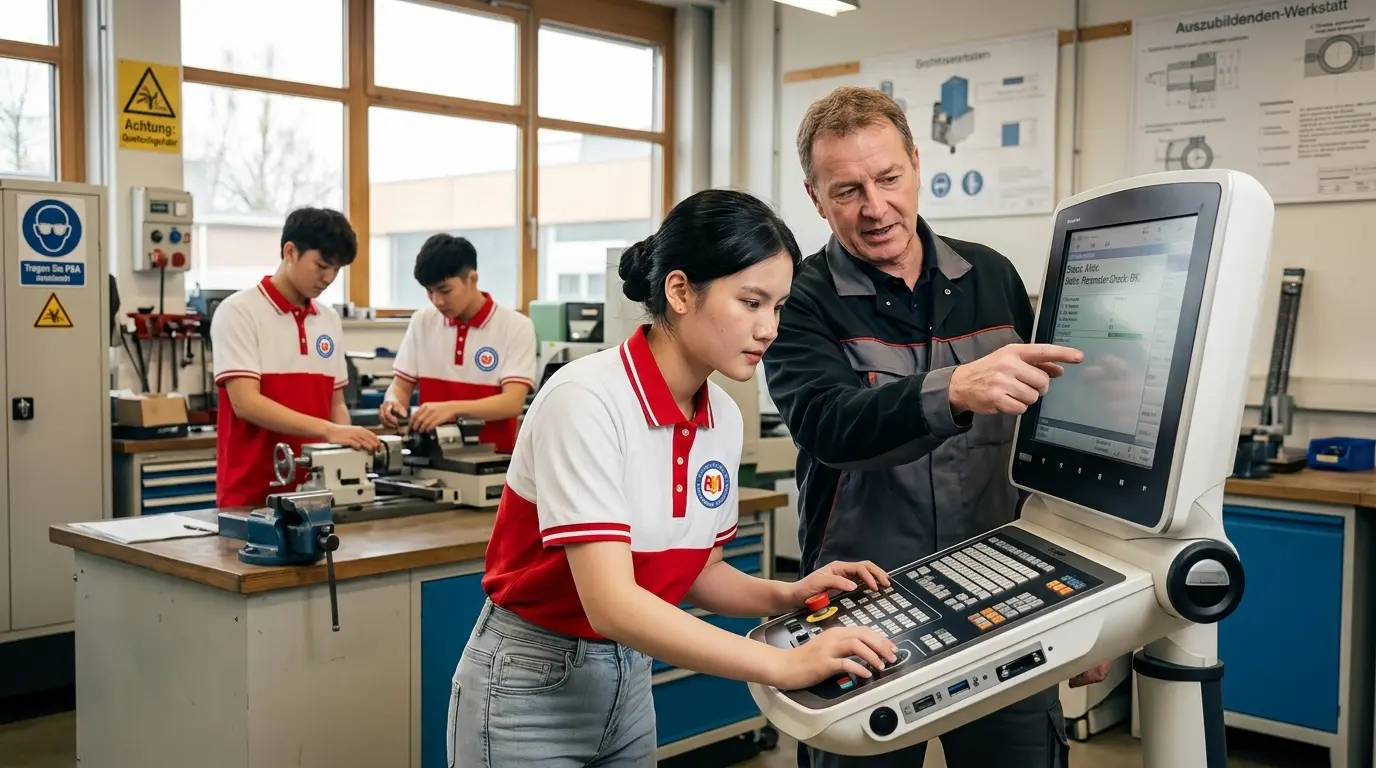
- Optimize the vocational learning process: Understand lectures, specialized vocabulary, and working procedures in Germany more easily when you master the native language of the profession you follow.
- Communicate during internships and work: You can exchange with teachers, colleagues, and customers confidently, avoiding misunderstandings in daily work.
- Prepare for vocational exams and certificates: Many vocational programs in Germany require a certain level of German before being accepted or before completing an internship semester.
- Increase settlement opportunities after graduation: Residency permit mechanisms for skilled workers in Germany increasingly emphasize the ability to communicate and accumulate work experience in German.
Challenges when starting the journey of learning German and vocational study
No one denies that German has a different structure and phonology compared to Vietnamese or English. That is one of the initial challenges many of you face when starting to learn a new language:
- Volume of vocational vocabulary: Each profession has its own vocabulary, requiring time to accumulate and continuous practice.
- Difficulty of grammar and syntax: Verb cases, compound nouns, and conversational tones in the working environment require linguistic sensitivity.
- Time and financial pressure for courses abroad: Sometimes the vocational study schedule and living costs can cause psychological and financial pressure for your family.
- Cultural barriers and adaptation to the working environment in Germany: Integrating with colleagues and a standard working environment can bring initial stress.
To overcome these challenges, here are some practical tips based on experience working with many students:
- Choose German courses focused on vocational communication and German for professional goals (linked to the industry you wish to study or work in).
- Start early, beginning with level A1-A2, then up to B1-B2 before entering vocational classes or participating in internships in Germany.
- Practice continuously: talk to native speakers, join language clubs or language exchange groups to enrich your vocabulary and specialized expressions.
- Find a counselor or mentor in the vocational study program to receive concrete feedback and adjust the learning roadmap.
German language roadmap for vocational study and settlement in Germany: from basics to career opportunities
Planning clearly from the start will help you save time and costs, while increasing the chances of success in your study and settlement goals in Germany. Below is a suggested reference roadmap; depending on each industry and the state where you plan to study, the steps can be adjusted accordingly:
- Preparation stage before going to Germany:
- Enroll in a general German course (A1-A2) and supplement vocabulary related to your chosen profession.
- Complete a B1 level German certificate or equivalent before starting the vocational course or participating in the first internship.
- Collect documents and confirm admission at a vocational training center in Germany through partners or support programs for foreign students.
- Vocational study stage in Germany:
- Allocate time between theory and practice to consolidate vocational vocabulary and work skills.
- Improve communication skills with colleagues and customers in German in daily situations and during shifts.
- Assess progress and prepare for exit exams or certificates related to the profession.
- Post-vocational course and settlement stage:
- Explore visa mechanisms for skilled workers and prioritize language learning suitable for the requirements of each state.
- Prepare residency applications based on profession and social integration ability in Germany.
- Continue to improve German proficiency and accumulate work experience to increase the probability of long-term settlement.
The above timeline can be adjusted depending on the profession and individual conditions. In reality, many of you have recognized the importance of learning the language early to expand job search opportunities after completing the vocational course.

An important part is that you feel true companionship in this process. Therefore, if necessary, find a reputable partner with experience supporting German vocational study in Vietnam for detailed advice on the roadmap and specific steps for your case.

Learning German for study abroad – Why choose PDT as a starting point?
Learning German is the first and most important step on the journey to conquering the dream of studying abroad in Germany. With a methodical, high-quality, and experienced training program, PDT Foreign Language & Study Abroad Center is a top choice for many students nationwide. With over 10 years of operation in foreign language training and study abroad consultancy, PDT has accompanied thousands of young people to get closer to opportunities to study and work in Germany.
The center was founded by Mr. Phan Dinh Thu – Vice President of the Vietnam – Germany Friendship Association of Ho Chi Minh City, who also established the IBA HCM branch, the exclusive organizer of ECL certificate exams in HCM City – one of the German certificates recognized by the German Consulate.
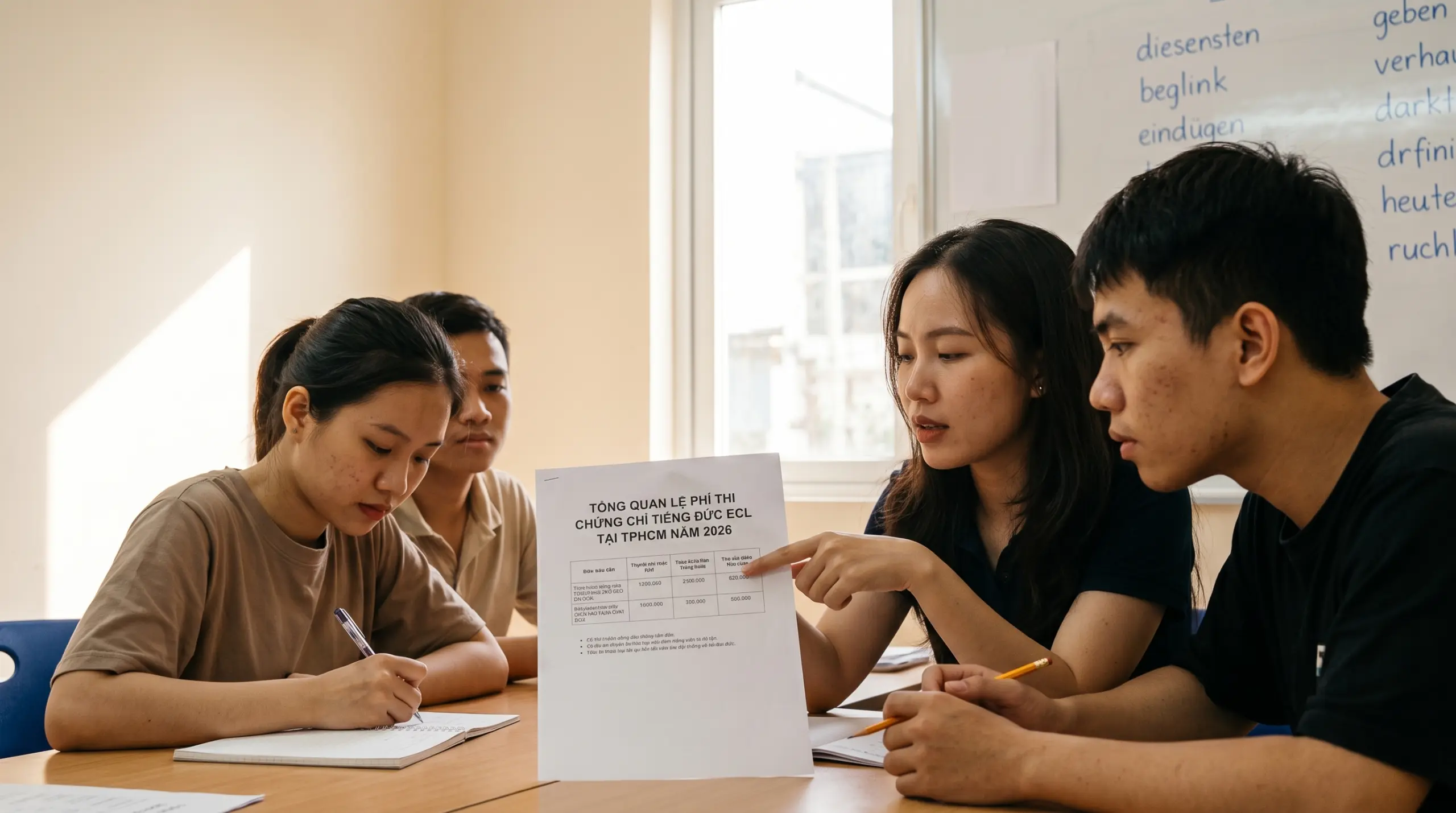
The curriculum at PDT stands out with German teachers teaching right from level A1 (Mr. Heiko, Mr. Sonny) along with a team of Vietnamese lecturers such as Ms. Nhan, Ms. Tuyen, Ms. Lan, Mr. Nguyen – all of whom have studied, lived, and worked in Germany, teaching with dedication and following each student closely. The center commits to real learning – real exams, provides free textbooks, uniforms, and tutoring until students pass B1, with free re-learning and exam review if needed.
The cost of studying at PDT is very competitive, divided into 5 installments, only collecting tuition when the visa is issued, supporting professional visa documentation with a 100% pass rate. In addition, the center picks up students at the airport, supports integration upon arrival in Germany, and commits to a refund if a suitable vocational unit is not found (for students who already have B1).

Conclusion: Should you start learning German for German vocational study and to increase settlement opportunities?
The short answer is yes, it is beneficial if you have clear goals and a specific roadmap. German is not just a communication tool; it is the key to opening many career opportunities in Germany and the possibility of long-term settlement. However, to achieve the desired results, you need patience, consistency, and to choose the right curriculum combining language and profession. View this as a long-term journey that can bring real impact to your career and long-term future in Europe.