
German Learning Guide For Beginners 2026
For many young Vietnamese people, A1 is the foundation to open the door to vocational study in Germany. Not just learning a language, A1 is also the key for you to understand how to work, communicate in the labor environment, and prepare for suitable vocational certificates. With experience and practical connections between Vietnam and Germany, a reputable unit can help you stay on track and avoid “pitfalls” in the early steps. PDT International Education provides an A1 roadmap linked to professional reality and recruitment needs in Germany, helping you have a clear and reliable study plan.
Part 1 – Starting with German A1: Goals, basic phonetics, and connections to German professions
Learning German A1 is the introductory step: you will get acquainted with German phonemes, basic vocabulary, and simple sentence structures. The goal of this stage is not just to remember words but also to form listening-speaking habits to communicate confidently in daily situations and in early-stage work environments.
- Understand and correctly pronounce basic German sounds (e.g., “ch” in “ich”, “ä” in “Tätigkeit”).
- Build a vocabulary of common professional topics (e.g., electrical work, mechanical engineering, healthcare).
- Get familiar with basic communication patterns: greetings, self-introduction, asking and answering job-related information, getting to know colleagues.
- Grasp basic grammar rules to form simple sentences with correct intonation.

Within the framework of the German A1 curriculum, lessons usually combine listening-speaking with brief reading-writing practice, to help you participate in preliminary interviews or exchange with native speakers from the very beginning. According to 2024 data from our partners, more than 70% of students start to see clear improvements in pronunciation and communication confidence after 6-8 weeks of basic A1 study. This shows that starting correctly will create a solid foundation for the next steps on the journey vocational training in Germany.
Part 2 – Practice and application in professional reality: Roadmap, resources, and associated challenges
The key point of A1 is not just learning vocabulary or grammar but turning what is learned into communication skills that can be applied in the work environment. This is when you start to see the connection between language and profession in Germany.
Benefits and Challenges
- Benefits: the ability to communicate briefly and confidently in German with German colleagues or work managers, understanding work requirements and basic work processes; the foundation for participating in vocational training or internships in Germany.
- Challenges: listening comprehension in German is fast-paced, especially when it involves work instructions or process descriptions. Additionally, the concept of “phonetic nuances” and the coordination between verbs and nouns can confuse you in the early stages.

To overcome these challenges, here is some practical advice from the center:
- Establish a daily listening habit: listen to podcasts short items or note down vocabulary accompanied by images of the work you are interested in (e.g., machine repair, production processes, quality control).
- Practice pronunciation and intonation with short daily exercises: 5-10 minutes retelling the main points of a short video about a profession related to the industry you want to study in Germany.
- Practice basic work situations right in class: welcoming customers, receiving job descriptions, requesting instructions, or asking again when not understanding.
- Take quick notes and review systematically: each week add 15-20 new words related to your chosen profession and review them 3 times through speaking-listening-writing.
To illustrate specifically, below is a suggested roadmap table for the professional-related A1 stage, applicable to many popular industries in Germany within the framework of German language training for vocational study:
| Stage | Main content | Estimated Time | Note |
|---|---|---|---|
| Phase 1 | Phonetic start-up, basic vocabulary, short sentences, greeting communication | 4-6 weeks | Focus on standard pronunciation, listening to standard native German voices |
| Phase 2 | Develop professional vocabulary, job description sentence patterns, work situation Q&A | 6-8 weeks | Form sentences with verbs in the 1st and 2nd person, pay attention to prepositions related to the profession |
| Phase 3 | Review, exam/and application in reality – communication in the work environment | 2-4 weeks | Cooperation between listening-speaking and short reading-writing (notes, job descriptions) |

Within this roadmap, several techniques are used to enhance learning efficiency, such as: small group discussions on professional situations, simulated recruitment interviews, and topical vocabulary repetition exercises. These techniques help you not only master the language but also form the habit of thinking in German regarding work and working habits in Germany.
Part 3 – Student stories and practical advice
To help you better visualize the reality of learning A1 and the vocational study journey, here is a true story from a student who experienced this roadmap from the very beginning until the end of the language stage and is ready for the next step.
Student story: From zero to confident professional communication in Germany
Nam is a young man from Hanoi who had never studied German before. He was worried that he would not keep up with the teaching pace and felt left behind in the phonetics part. According to his sharing, the beginning encountered many difficulties with sounds and how to combine words in sentences.
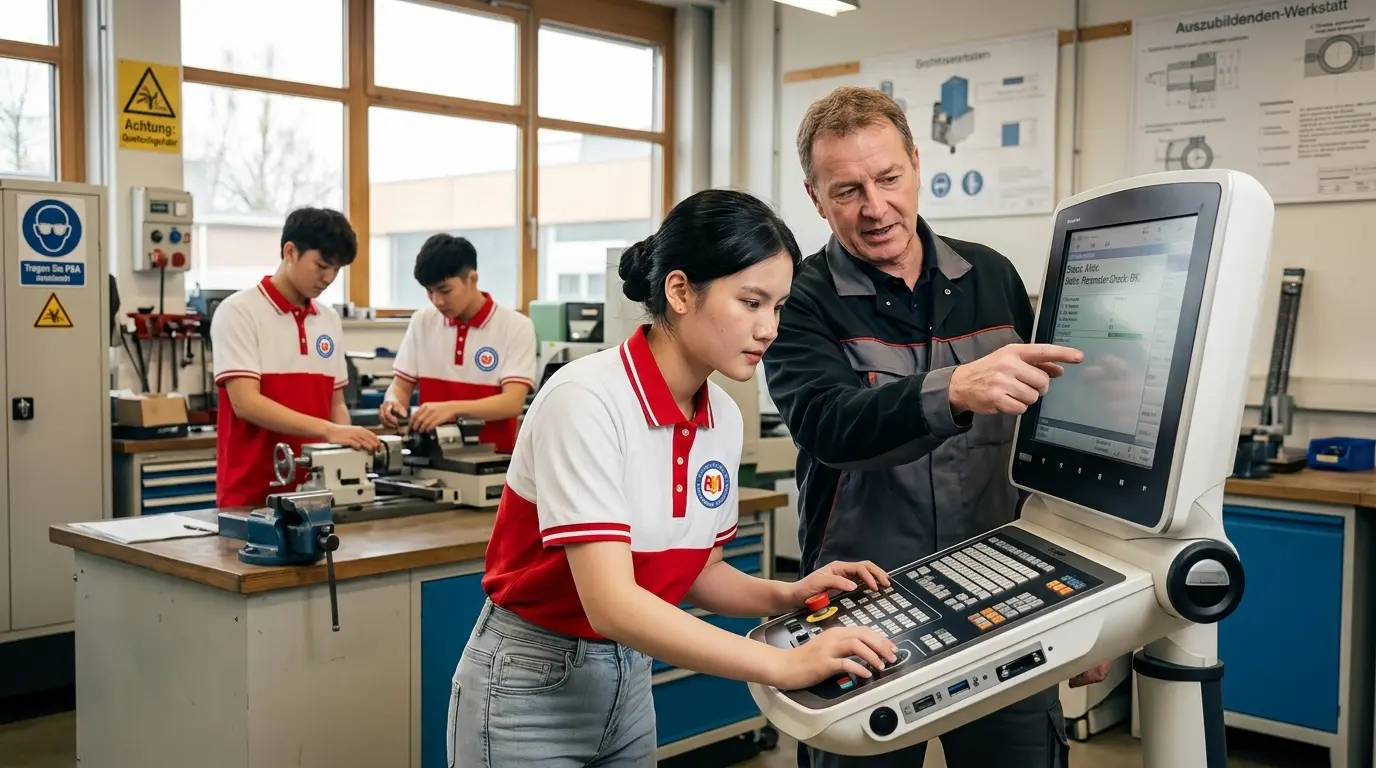
“I remember days in class when I just wanted to burst into tears because everyone spoke so fast. But the teacher took the time for me to practice pronouncing each individual sound and provided sample sentences suitable for the profession I was interested in: welding, machine repair, lathe machining. After about 8 weeks, I started to understand short instructions in German and could introduce myself in the new language.”

Nam said: “As soon as I had the tools and basic grammar framework, I started participating in professional discussion sessions, and surprisingly, my classmates helped a lot. We practiced listening to short dialogues about work processes and competed in speaking in front of the mirror to improve confidence.”
At the end of the A1 stage and moving into more intensive practice courses, Nam realized the importance of connecting with the potential workplace community. He continued to participate in a short-term internship program at a factory in Central Germany when his visa was granted, and thanks to his basic vocabulary, he could understand job descriptions and get acquainted with quality control processes. Nam's story shows that a person who is not a language genius can still achieve their goals with patience, a plan, and appropriate support from local educational units and partners in Germany.
Many students have stated that systematic guidance and feedback from the beginning helped them build confidence and motivation. According to 2024 data from partners, the majority of students after the A1 course were able to participate in basic professional communication activities, and a significant proportion of them could practice professional interviews in German for the goal of vocational study in Germany.
Practical advice on guiding German language learning for beginners in preparation
- Set clear learning goals for each week and each professional topic. For example: this week focus on vocabulary related to electricity and machinery; next week express maintenance processes and occupational safety.
- Practice speaking every day for at least 10-15 minutes: record your speaking and compare it with standard pronunciation samples, then gradually adjust based on feedback from teachers or classmates.
- Remember to note down terms and sample sentences related to the profession you want to study in Germany, and regularly review them by forming complete sentences instead of just remembering individual nouns.
- Participate in interview simulations or exchanges with native speakers to get used to expressing answers and understanding the interviewer's point quickly.
- Especially for those planning vocational study via visa support programs, prepare a basic German profile and notify the center early about your career goals to receive orientation suitable for German standards.
Your anchor in the language journey is perseverance and understanding what Germany expects from candidates. With a program designed based on professional reality and contact with potential employers, learners can see clear progress and be motivated to continue to higher levels. That is part of the reason why many students, after completing A1, have continued to participate in further practice courses at the same unit or transferred to related vocational courses in Germany through our partners.

Conclusion: The A1 journey is the start of career opportunities in Germany
Learning German A1 is not just accumulating vocabulary and grammar, but also how you form the confidence to participate in a new work environment where language plays a key role in communication and workplace safety. You are not alone on this journey. The team of teachers and advisors at the center are ready to help you allocate time, choose suitable career goals, and provide practical feedback so you progress every day. With clear orientation and a reasonable study plan, you can turn A1 into a solid stepping stone for the German vocational study process, thereby opening up opportunities to work and develop a career in Europe.
If you are considering starting A1 or want to understand more about career options in Germany and how to connect with study visas, contact our consulting unit for orientation suitable for you. Those participating in courses and practice sessions at affiliated partners can receive practical suggestions, helping you catch the pace quickly and be more confident on the vocational study journey. PDT International Education always values discretion and expertise in every support step, thereby helping you have the best preparation for the upcoming road.
Start today by defining your career goals and scheduling A1 study suitable for your time. The time spent learning German can be a decisive decision for your professional future in Germany. With the right amount of care and seriousness, you will find yourself closer to the dream of studying and working in a strong, opportunity-filled economy like Germany.
Finally, remember that everyone has their own pace. Read carefully, practice regularly, and do not hesitate to ask instructors when encountering difficulties. You will be surprised by small daily progress, and those small steps will lead you to larger goals. If you want further advice on a roadmap suitable for you, we – in the role of an educational and consulting unit – are always happy to share specific information and useful suggestions. See this as the start of a meaningful and sustainable journey.
Engaging with the learning process, you can feel real progress and superior confidence every time you open a new German syllable.”
Those considering German vocational study can refer to more information from partner sources and our study programs to find the best fit for their own conditions and goals. In any case, starting from A1 is the right decision, and a reasonable plan will help you conquer future goals.