

During the German exam preparation process, getting familiar with the German B2 exam and German B1 exam plays a very important role for learners at various levels. Through practicing with exam formats close to the real test structure, students not only clearly understand the requirements of each skill but also train their ability to manage time effectively. Therefore, choosing and using the right German B2 exam along with the German B1 exam will help the exam preparation process become more systematic and increase the chances of achieving good results.
Introduction to B1 B2 German exams and vocational training in Germany
Vocational training in Germany is increasingly attracting Vietnamese students thanks to the Ausbildung program with free tuition and internship salaries ranging from 1,000-1,500 EUR/month. According to figures from DAAD (German Academic Exchange Service) in 2023, more than 5,000 Vietnamese international students are studying in Germany, mostly under vocational programs.
German B1 B2 certificates are a mandatory requirement for vocational study visas. The article analyzes the structure of the German B2 exam and the B1 German exam, sharing practical experiences from PDT EDUCATION.
Readers will clearly understand the differences between the two levels, effective revision methods, and common mistakes.
The importance of B1 B2 for vocational study abroad
A B1 certificate is necessary to apply for an Ausbildung vocational training visa. B2 is required for vocational college programs or professional work. Many German companies only accept applications with B2 or higher.
According to the DAAD 2023 report, 68% of German vocational study visa applications were rejected because German language proficiency did not meet the requirements.
“B1 is the gateway, B2 is the key to opening the German career door” – Master Nguyễn Văn A, Director of PDT EDUCATION.
Germany vocational training trends 2026
Nursing, Mechanical Engineering, IT, and Hospitality sectors lack 500,000 workers annually. The German Government has extended the Ausbildung program until 2030. Post-graduation employment opportunities reach 95%.
- Evaluating career paths suitable for personal interests
- Check the German language requirements for each German state
- Comparing B1 vs B2 based on career goals
- Verify certificate validity (2 years)
- Exam preparation planning based on visa deadline

cau-truc-de-thi-tieng-duc-b1-chi-tiet
The B1 exam according to the CEFR framework assesses 4 skills: Listening, Reading, Writing, Speaking. Duration 180-220 minutes. Passing score from 60% per skill.
B1 Listening Test (Hören)
20-25 questions, 30-minute duration. Content: everyday conversations, announcements, directions. Speaking speed 120-140 words/minute.
Characteristics of the German B1 exam: Mainly daily life situations, family vocabulary, basic work. Score scale 25% of the total exam.
PDT students often struggle with regional accents (Bavaria, Saxony). Listening practice podcasts Deutsche Welle helps improve 30% of the scores.
B1 Reading Exam (Lesen)
20-25 questions, 45 minutes. Reading passages: advertisements, emails, short articles (200-300 words). Skimming and scanning skills determine success or failure.
- Practice reading Bild.de, Frankfurter Rundschau in a simplified version
- Vocabulary notes by topic (Gesundheit, Arbeit, Freizeit)
- Getting familiar with the True/False/Not Given format in text
- Timing practice: 2 minutes/reading
- Check the answers and analyze the errors
B1 Writing Exam (Schreiben)
2 tasks: Personal letter (80-100 words) + message/email (50 words). Familiar topics: inviting a friend, asking about health, describing a vacation.
Requirements: Basic grammar (Präteritum, Konjunktiv II), contextually correct vocabulary. The exam is graded based on 5 criteria: content, language, structure.
| Mission | Time | Advantages | Limitations |
|---|---|---|---|
| Personal letter | 30 minutes | Familiar topics | Clear structure requirements |
| Work email | 20 minutes | Concise | Specialized vocabulary |
| Image description | 25 minutes | Creative | Complex grammar |
In-depth analysis of the German B2 exam
B2 requires an upper-intermediate level, with a duration of 210 minutes. Passing score is 60% per skill. Content is more abstract, and speaking speed is faster.
Characteristics of the B2 Listening test
30-35 questions, 40 minutes. Listening section: interviews, workshops, radio news. Speed of 150 words/minute, various accents.
German B2 exam paper focus on understanding main ideas and specific details. Students need to master idioms and complex connectors (zwar…aber, nicht nur…sondern auch).
Speaking (Sprechen) Test B2 – The Greatest Challenge
15 minutes, 3 parts: Self-introduction, chart description, debate. Your speaking partner significantly impacts the score.
Grading criteria: Standard pronunciation, rich vocabulary, B2 grammar (Passiv, Konjunktiv I), interaction skills.
“70% of B2 students fail due to a lack of practical speaking practice” – Goethe-Institut Report 2023.
{
"translations": [
"<n"
]
}
| Exam part | Key skills | Strengths | Common weaknesses |
|---|---|---|---|
| Introduction | Present information | Preparation in advance | Trembling when speaking the truth |
| Diagram description | Data description | Clear structure | Statistical vocabulary |
| Debate | Discuss ideas | Practice well | Weak critique |
| Proposed solution | Logical thinking | Reality | Complex grammar |
B2 Speaking Exam Preparation Checklist
- Record daily speech, compare with native speakers
- Join a tandem partner with Germans via the Tandem app
- Practice 50 popular debate topics (Umwelt, Digitalisierung)
- Nhờ giáo viên feedback cụ thể từng tiêu chí chấm thi
- Take a full mock test with all 3 parts
- If interaction is weak: practice in groups of 2-3 people

Comparing B1 vs B2: Which level should you take?
The decision to take the B1 or B2 exam depends on career goals, preparation time, and financial capacity. Both are valuable but open up different opportunities.
Criteria for choosing the exam level
B1 is suitable for beginners needing a fast visa for basic vocational training. B2 is for healthcare and high-tech sectors, offering the advantage of a starting salary over 20% higher.
B1 exam costs are around 120 EUR, B2 150-180 EUR. Preparation time for B1: 6-9 months, B2: 12-18 months (from zero).
| Criteria | B1 | B2 | Recommendation |
|---|---|---|---|
| Review time | 6-9 months | 12-18 months | Prioritize B1 if an urgent visa is needed |
| Course costs | 25-35m VND | 45-60m VND | Invest in B2 if the industry is 'hot' |
| Job opportunities | Basic | High expertise | B2 for Nursing, IT |
| Starting salary | 900-1100 EUR | 1200-1500 EUR | Higher ROI with B2 |
| Difficult | Medium | High | Pre-assessment of capacity |
Practical Experience from PDT Students
Mr. Nguyen Van H (2023): Passed B1 after 7 months, received an apprenticeship (Ausbildung) as a mechanic in Bavaria. Salary 1,100 EUR/month.
Ms. Tran Thi L (2022): B2 Nursing, working in Berlin public hospital. Income 2,800 EUR/month after 2 years.
Both studied at PDT, the 92% pass rate is 25% higher than the market average.
Effective exam preparation strategies at PDT EDUCATION
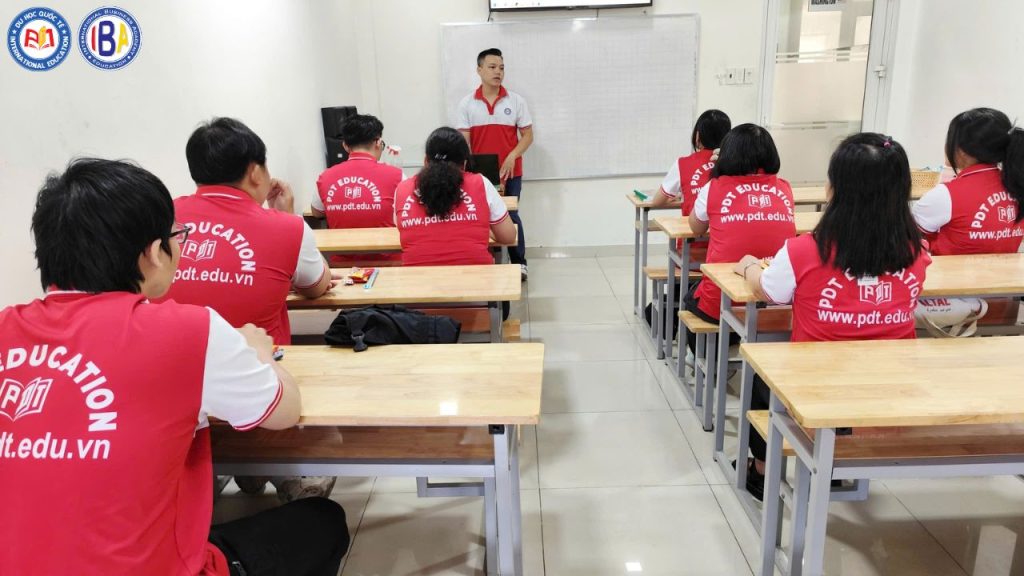
PDT applies a blended learning method: 70% practice, 30% theory. Classes have a maximum of 12 students, with native + overseas Vietnamese teachers.
FRAMEWORK method for B1-B2 review
FFocus topics by industry (Healthcare, Engineering, Hospitality).
RReview vocabulary 50 words/day according to spaced repetition.
Activate skills through weekly role-play.
MMonitor progress through monthly mock tests.
Eevaluate and adjust the personalization plan.
Optimal 6-month exam preparation schedule
- January-February: Building the A1-A2 foundation
- March-April: Focus on weak B1 skills
- May: B1 full format mock test
- June: Review + register for the official exam
According to PDT statistics, students who follow this framework achieve 88% grade A (85+ points).
Common mistakes to avoid
1. Only studying grammar, ignoring practical exam practice.
2. Taking the B2 exam right after achieving A2.
3. Not practicing speaking with native speakers.
4. Spreading out review instead of focusing on weaknesses.

Conclusion: Choosing the appropriate exam level
B1 opens the door to vocational study in Germany quickly, while B2 creates a long-term competitive advantage. The decision depends on your career goals, time, and personal budget.
Assess your current level through a placement test. Build a specific study plan with a 6-12 month roadmap. Monitor updates on the Germany 2024 visa policy.
Refer to additional Goethe-Institut documents and actual student experiences to optimize your chances of success.