

Many workers are concerned about how to get your qualifications recognised in Germany. This is an extremely important legal step when developing a career in Europe. This assessment process is a mandatory gateway. It helps you obtain official recognition of your professional qualifications and work legally for German companies.
According to 2026 figures, Germany faces an annual shortage of more than 400,000 skilled workers. The Federal... Skilled Immigration Act has recently created more favourable conditions for foreign nationals. However, qualification assessment requirements remain strict. The legal system demands complete transparency regarding professional competence.
The following article will guide you through the entire procedure. You will learn about each step involved in preparing the essential documents. You will also know how to budget accurately. This will help you minimise the risk of having your long-term work visa application rejected.
What Is Recognition of Qualifications in Germany and Why Is It Mandatory?
Diploma recognition is the process of assessing foreign qualifications against the German education system. Government authorities will examine your professional knowledge in detail. This assessment system is based on their rigorous dual vocational training standards.
Definition and Legal Significance
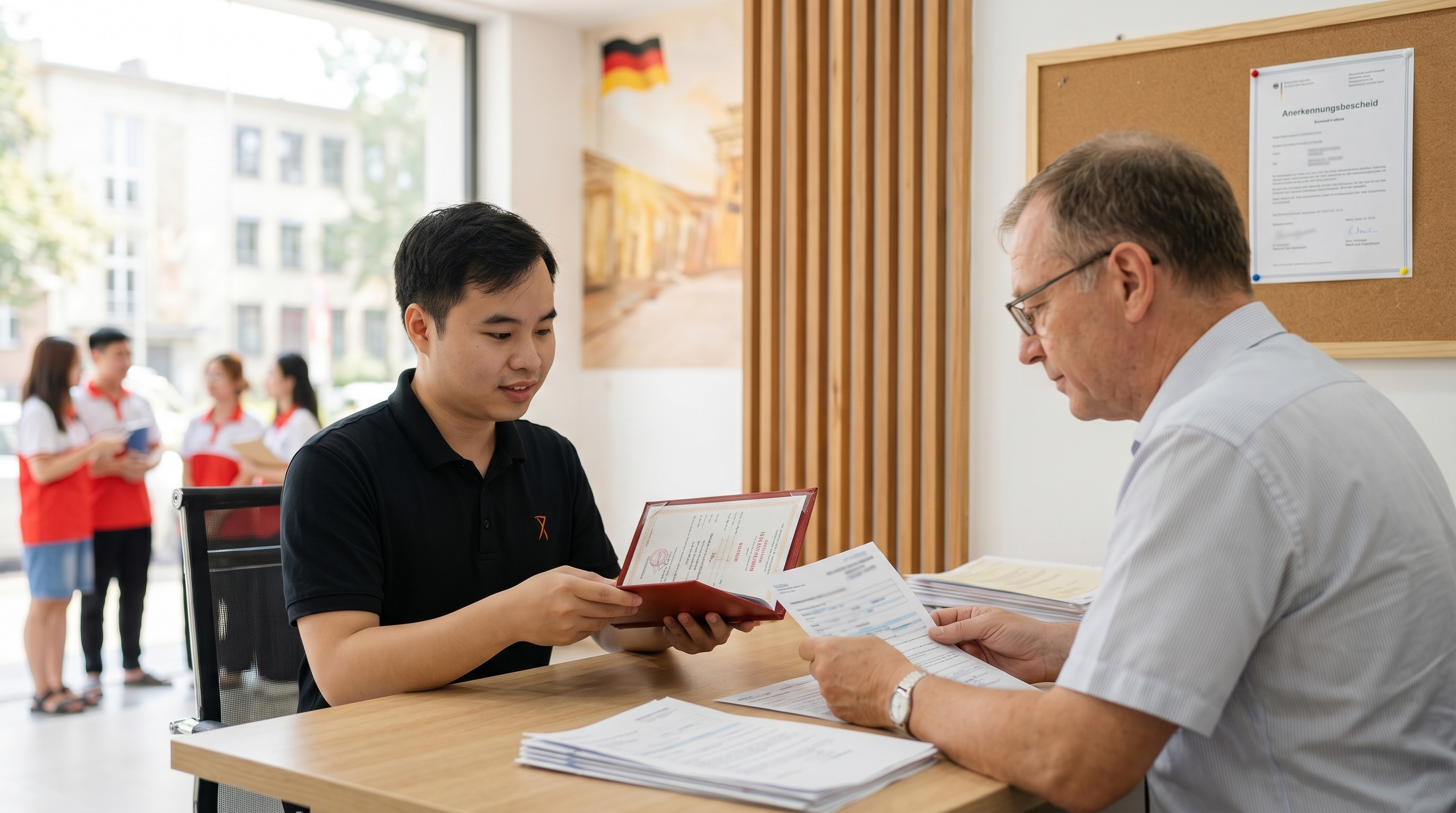
This is a mandatory procedure for applying for a skilled worker visa. Without this certificate of recognition, you cannot legally practise your profession. The competent authorities will compare the number of hours you spent on theoretical study. They will also carefully assess the duration of your practical training.
Strictly Regulated Occupational Sectors
The German labour market is divided into two distinct categories: regulated and non-regulated professions. Regulated professions require a licence before you can work. If your profession falls into this category, the recognition procedure is essential.
- Healthcare Sector: Nurses, doctors, pharmacists and physiotherapists.
- Education Sector: Early childhood educators and primary school teachers.
- Safety-Critical Technical Sector: Civil engineers and industrial electricians.
- Public Services Sector: International lawyers and senior public-sector accountants.
- Skilled Trades Sector: Automotive mechanics and highly skilled carpenters.
Income Benefits and Residence Rights
Holding a certificate confirming equivalence helps you negotiate the highest possible salary. You are entitled to the same healthcare benefits as local citizens. This is a prerequisite for applying for an EU Blue Card. It also opens up opportunities for long-term settlement in the future.
Example 1: Nguyen Van An (Quang Nam) graduated from a vocational college in Mechanical Engineering in Vietnam. After completing the qualification recognition process, An secured a job in Stuttgart. His starting salary was €2,800 per month in his first year.
Example 2: Tran Thi Bich (Hai Phong) is a nurse with three years of experience. Thanks to partial recognition of her qualifications, she only needs to complete six months of additional training in Berlin. She does not have to repeat the entire three-year vocational training programme.
Practical tips: Check your qualifications in advance using the online Anabin database. This will help you determine whether your university is recognised in Germany with H+ status.
| Comparison criteria | Regulated professions (Reglementierte Berufe) | Non-regulated professions (Nicht reglementierte Berufe) |
|---|---|---|
| Recognition requirements | 100% mandatory to obtain a legal licence to practise | Not legally required, but strongly recommended |
| Examples of professions | Nurses, doctors, teachers, lawyers | Information technology, business administration, design |
| Competent recognition authorities | The health and education authorities of each individual federal state | Central Office for Foreign Education (ZAB) |
| Key Benefits | Obtaining a professional licence in your qualified field | Better job prospects and greater ease in negotiating a higher salary |
A Comprehensive Guide to Preparing the Documents Required for Qualification Recognition in Germany
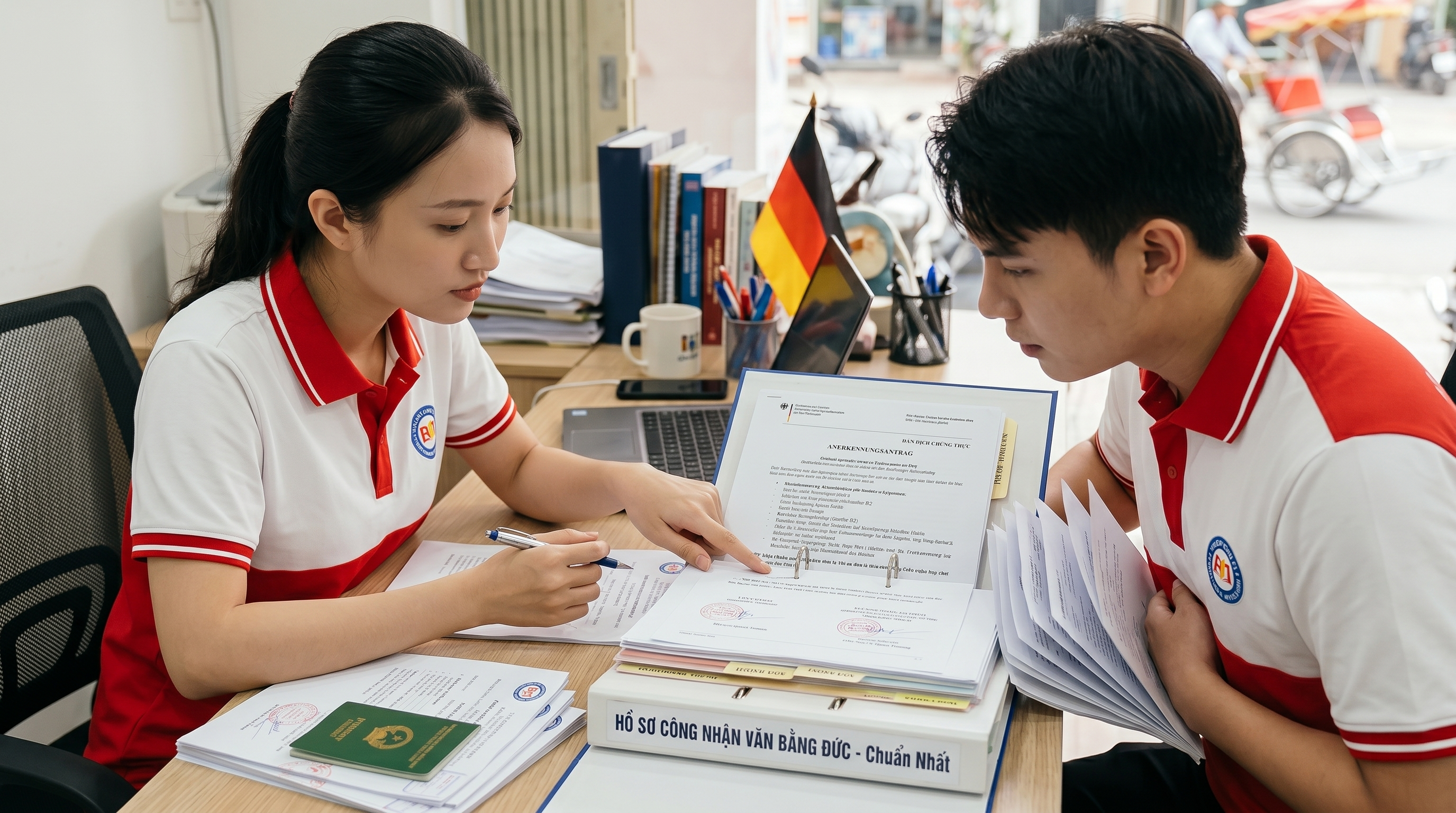
A set of Documents Required for Qualification Recognition in Germany Proper preparation is crucial and can determine up to 80% of the chances of success. Germans are extremely strict when it comes to administrative procedures. All documents must comply with the exact format required by the relevant federal state.
Essential Academic Documents
You must provide complete evidence of your educational background in Vietnam. These documents demonstrate the extent of the knowledge and skills you have acquired. All information on your degree certificate and academic transcripts must match exactly.
- A valid passport copy with a clearly visible signature.
- An official graduation certificate from a university, college or vocational training institution.
- Detailed academic transcripts clearly stating the total number of credits and study hours.
- Proof of relevant work experience (social insurance records, employment contracts).
- An accurate CV prepared in accordance with the European Europass CV format.
Translation and Notarisation Requirements
Based on PDT EDUCATION's experience, the most common mistake is failing to follow the required translation procedures. Documents must be translated by sworn translators in Germany. Certified true copies must be issued by the German Embassy or the relevant government authorities.
Foreign language certificate requirements from the Consulate
Depending on your profession, you will need the corresponding German language certificate. The healthcare and education sectors usually require B1 or B2 level. The following Goethe-Institut language certificates or telc certificates are also officially accepted. The certificate must have been issued within the last 12 months.
Example 3: Mr Lê Hoàng Long (Ho Chi Minh City) submitted an application for the recognition of his Information Technology qualification. As he had his transcript translated himself at a small notary office, Long's application was rejected. Incorrect technical terminology delayed the process by two months.
Example 4: Ms Phạm Mai Anh (Can Tho) applied for recognition of her Chef qualification in Leipzig. By preparing her previous employment contracts and reference letters in full, she was able to have her experience recognised by the HWK. Her required internship period was reduced by one year.
Practical tips: Never submit original documents unless the assessment authority requests them in writing. Always send certified true copies to avoid permanent loss.
How to get your qualifications recognised in Germany: A four-step process
To provide a complete answer how to get your qualifications recognised in Germany, you need to follow the steps below. Each German federal state operates under its own legal system. Consequently, processing times may vary slightly.

Step 1: Find and identify the competent assessment authority
Start by searching for your profession on the Anerkennung in Deutschland portal. The system will identify the responsible authority for the relevant federal state. Commercial professions fall under the IHK, while skilled trades fall under the HWK.
Step 2: Submit your application and pay the fees
Once you have gathered all the required documents, submit your application by post. Some federal states allow applications to be submitted through an online portal. Shortly afterwards, you will receive a notification requesting payment of the fee. The assessment process only begins once the payment has been received in their account.
Step 3: Wait for the Assessment and Receive the Recognition Decision
The statutory processing time is 3 to 4 months. The competent authority will carefully compare your training curriculum with the relevant requirements. The final outcome will fall into one of the following three categories.
- Full Recognition: Your qualification is deemed fully equivalent, allowing you to practise your profession immediately.
- Partial Recognition: There are skills gaps, and you will receive a deficiency notice (Defizitbescheid).
- Non-Recognition: Your qualification differs too significantly from the vocational training standards.
- Appealing the Decision: You have the right to submit an objection within one month.
- Additional Documentation: You may submit additional documents if the authority requests further clarification.
Step 4: Attend a Supplementary Training Course
If your qualification is only partially recognised, you must attend qualification conversion programme is compulsory. This may involve a theoretical course or an internship lasting between 6 and 18 months. These help fill the gaps in your knowledge.
Example 5: Mr Dinh Van Toan (Da Nang), an automotive engineer, submitted his application to the IHK authority in Munich. He received a full recognition assessment after 3 months. His training programme matched the German training framework exactly.
Example 6: Ms Ngo Phuong Lan (Binh Duong) graduated with a college diploma in general nursing. The assessment required her to complete an additional 8 months of professional training. After completing the course in Frankfurt, she was officially granted a professional licence.
Practical tips: When sending documents by international post, always purchase a tracking number. This ensures that your valuable application documents reach the intended recipient.
German Qualification Recognition Fees and Tips for Cost Optimisation
Sound financial preparation helps you avoid interruptions to the process. German Qualification Recognition Fees depend on the occupation and federal state. Incorrect cost estimates can lead to significant difficulties.

Government Fees and Administrative Processing Charges
Government assessment fees range from 200 to 600 euros. Certain specialised occupations may incur fees of up to 1,000 euros. These charges cover the work of independent application assessors. You must also cover international money transfer fees.
Additional Costs During the Preparation Process
In addition to official fees, you will need to pay for various supplementary services. Although these expenses may seem small individually, they can add up to a substantial amount. PDT EDUCATION recommends preparing a detailed budget from the outset.
- Certified judicial translation fees: VND 2–4 million.
- Consular legalisation fees at the Embassy: Approximately VND 1–2 million.
- Language course fees: Enrolment in specialised German B1 courses.
- International express courier fees (DHL): Ranging from VND 1 million to VND 1.5 million.
- Blocked bank account (Sperrkonto): Approximately EUR 1,027 per month as proof of financial means.
Tips for Preparing Your Finances Safely
Many employers in Germany are willing to cover all expenses to attract talented professionals. You should proactively seek opportunities with major hospitals or large companies. In addition, the German government offers small-scale financial assistance funds for workers.
Example 7: Trịnh Văn Hải (Hanoi) paid the qualification assessment fee himself, amounting to EUR 500 for technicians. However, due to an incorrect estimate of courier charges, Hải ran short of funds. He had to borrow additional money from his family at the last minute.
Example 8: Đỗ Tú Oanh (Đồng Nai) was fortunate enough to sign a contract with a nursing home in Hamburg. The nursing home committed to covering 100% of her qualification assessment fees and airfare. This saved her a substantial amount of money.
Practical tips: Keep all receipts for qualification assessment fees and language courses safe. When you pay taxes in Germany, these expenses may be eligible for income tax deductions or refunds.
Conclusion
Understanding how to apply for professional qualification recognition in Germany will help you take greater control of your journey towards building an international career. This is not merely an administrative formality; it is also an important stepping stone towards working in your chosen profession, increasing your income and expanding your opportunities for long-term residence in Europe.
The qualification assessment process requires thorough preparation, covering academic records, work experience, language certificates and financial resources. Even a minor error in the documentation or application procedure can significantly delay the assessment process.
PDT EDUCATION PDT EDUCATION is currently supporting many Vietnamese students and workers throughout the process of completing their professional qualification recognition applications in Germany. Drawing on practical experience in document processing, career guidance and legal support, PDT EDUCATION helps students save time, optimise costs and feel more confident about entering the German labour market.
>>> See other topics: The 7 Most Comprehensive Steps to Working in Germany Through Labour Export in 2026