

Many families are now interested in the all-inclusive costs of studying a vocational course in Germany, but remain concerned about additional unexpected expenses. In reality, preparing a clear financial plan from the outset will help parents take a more proactive approach and minimise risks during the application process, language studies and visa application.
With Germany facing a shortage of hundreds of thousands of skilled workers each year, vocational study has become a popular option for many Vietnamese students seeking to develop their careers and secure a stable long-term future. This article will help you understand each actual expense, the payment schedule and how to optimise your budget more safely before moving to Germany.
What Is Included in the All-Inclusive Cost of Studying a Vocational Course in Germany?
A standard service package usually covers everything from the start of language lessons until departure. Clear information helps families avoid sudden financial pressure. These costs are generally divided into stages. You should understand them thoroughly to compare different centres. Below are the main and most important items.

German Language Training and Certificate Examination Fees
Learning German is the first step and the one that takes the most time. You will generally need to reach B1 level before applying for a visa. This cost includes tuition fees for courses from A1 to B1. Examination fees for certificates issued by reputable organisations are also included. If you fail, you will have to pay for the resit yourself. Therefore, studying diligently is essential.
Translation and Consular Legalisation Fees
Documents submitted to the German Embassy in Hanoi require a high degree of accuracy. All Vietnamese documents must be translated into German. They must then undergo consular legalisation. These fees are generally not very high, but the process is compulsory. It requires professionals with the appropriate expertise.
- Notarised copies of the household registration book and citizen identity card.
- Translation of the upper secondary school graduation certificate.
- Translation of the upper secondary school academic transcript into German.
- Legalisation of the foundation certificate, if required.
- Health certificate according to European standards.
- Passport-sized photographs taken in accordance with the Embassy's requirements.
Detailed price list for German application processing services.
Document processing usually accounts for a significant proportion of the costs. In a German application processing service price list, companies charge consultancy fees. These cover finding vocational schools and practical training companies. They also handle the procedures for obtaining a training contract. This is the most challenging step for students applying independently. The fees depend on the occupation you choose.
Nam, a student from Dong Nai, chose Mechanical Engineering. With the help of a reputable centre, his application was processed quickly and smoothly. He received a practical training contract just two months after the interview. Meanwhile, Linh from Da Nang chose Nursing. She received a partial waiver of the service fee under an educational support scheme. Both were able to depart as planned thanks to thorough preparation.
| Cost Category | Estimated fees (VND) | Accompanying notes |
|---|---|---|
| German A1-B1 learning | 35,000,000 – 45,000,000 | Basic textbooks included |
| B1 exam fee (one attempt) | 4,500,000 – 5,500,000 | Depending on the organising body |
| Document processing and translation | 15,000,000 – 20,000,000 | Includes certified translation |
| Vocational employer search fee | 120,000,000 – 150,000,000 | Varies depending on the industry sector |
Why Choose an All-Inclusive Package for Vocational Training in Germany Instead of Applying Independently
Handling your application independently may help you save some money upfront. However, potential risks can often cause costs to multiply. Choosing a comprehensive service package provides complete peace of mind. Experts will support you in resolving any issues that arise. You can focus entirely on learning the language.
Minimise the Risk of Visa Rejection
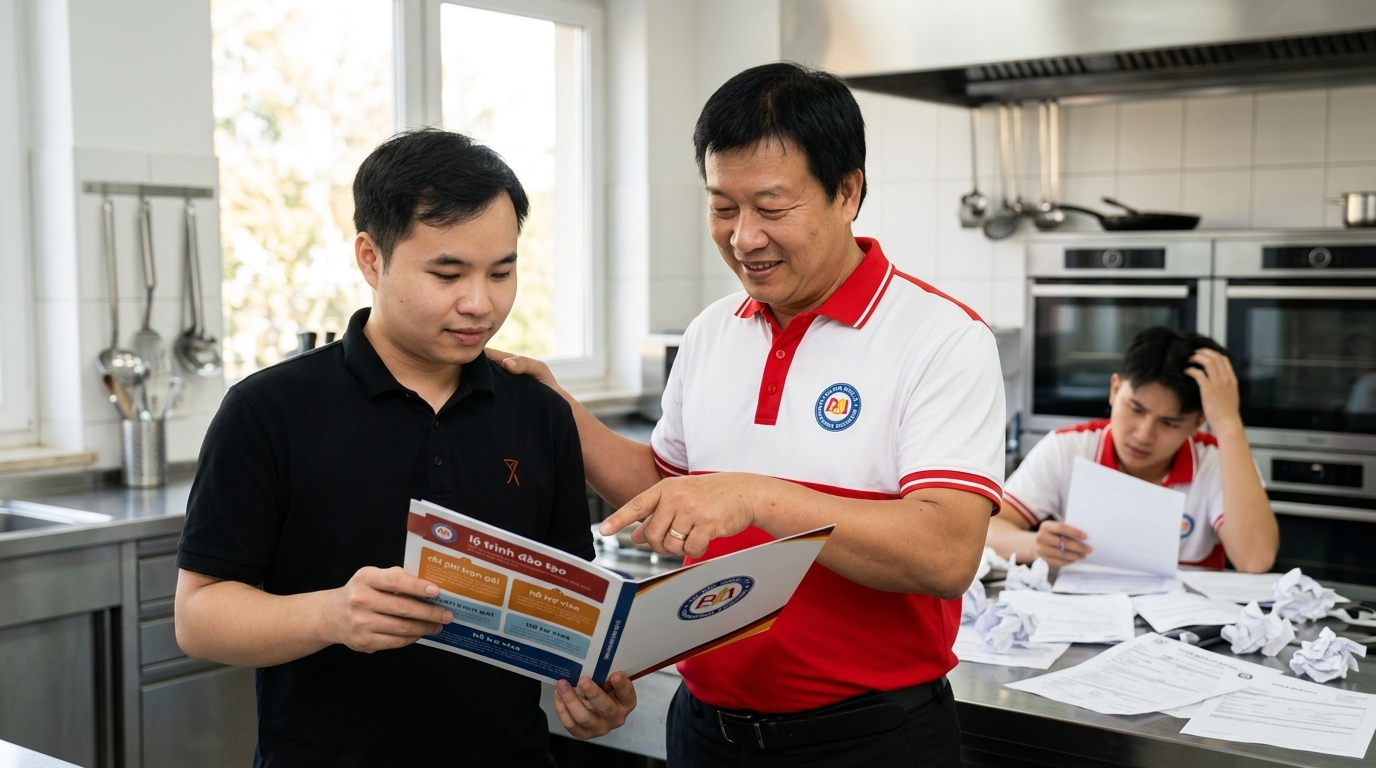
The German Embassy applies strict criteria when assessing vocational training visa applications. Even a minor mistake in your motivation letter can result in rejection. The visa application fee is non-refundable if your application is unsuccessful. Choosing an all-inclusive service ensures that your application is carefully reviewed. Experts understand the assessment criteria used by consular officers.
Save Time on Administrative Procedures
Waiting for a vocational training contract can take several months. Contacting German companies directly can be challenging due to language barriers. Consulting centres have established networks of partners in Germany. They can connect candidates with employers quickly. This helps you avoid missing the autumn or spring intake.
- Receive advice on choosing a vocational field that suits your abilities.
- Receive direct interview coaching with German business owners.
- Finalise the motivation letter in a style that meets German standards.
- Arrange the most suitable schedule for submitting your visa application.
- Assist with explaining your application if additional documents or clarification are requested.
- Closely monitor the progress of your application and the expected decision from the Consulate.
No unexpected additional fees guaranteed at PDT.
PDT EDUCATION recommends that parents choose service providers who offer written guarantees. Based on PDT EDUCATION's experience, many students have faced difficulties due to unexpected charges introduced gradually. With a clearly defined service package, families can manage their budgets with confidence. All fees are explained transparently before any agreement is signed. This helps build lasting trust between both parties.
Hoang from Can Tho once tried to prepare his own application for a Hotel and Restaurant Management programme. He submitted the wrong document forms, resulting in a visa refusal and the complete loss of his application fee. He subsequently sought professional advice and started the process again from scratch. In contrast, Mai from Hai Phong opted for a full-service package from the outset. Her application met all the requirements, and she obtained her visa in just four weeks. She is now working steadily in the city of Leipzig.
Financial requirements to prepare before departure
In addition to the service fees paid in Vietnam, you will need to prepare funds to take with you. These funds will cover your living expenses in Germany. The Embassy requires clear evidence of your financial means. You must open a dedicated account with a recognised bank. This is a mandatory requirement under the Skilled Immigration Act in its latest version.

Blocked Account (Sperrkonto) under the latest regulations
If your training salary does not meet the required threshold, you must make up the shortfall. A blocked account helps ensure that you do not become a burden on the social welfare system. The money remains yours and can be withdrawn in monthly instalments. The required amount may vary slightly depending on the federal state. You should regularly check the latest information from official sources.
Airfare and mandatory health insurance
One-way airfares to Germany fluctuate frequently. You should book your ticket early as soon as your visa is approved. Health insurance is also an essential requirement for entry into Germany. You will typically need to purchase travel health insurance for the first six months. Once you start working, you will switch to the statutory health insurance system.
- Register to open a blocked account through Expatrio or Coracle.
- Deposit the exact amount in euros required into the account.
- Print the account balance confirmation to include in your application documents.
- Search for flights with Bamboo Airways or Qatar Airways.
- Purchase international travel insurance with immediate coverage.
- Double-check all your personal identification documents before your departure date.
First-month living expenses reserve
The first month in Germany always involves many additional expenses. You will need to pay a rental deposit, purchase a monthly public transport pass and buy essential household items. Training salaries are usually paid at the end of the month. Therefore, you should bring some extra cash as a reserve. According to experts at PDT EDUCATION, around 500 to 800 euros is a safe amount.
Huy, from Thai Binh, brought 1,000 euros in cash when he moved to Frankfurt. He used the money to pay his accommodation deposit and buy a mobile SIM card. Thanks to his careful preparation, he did not run short of money before receiving his first salary. Châu, from Lam Dong, brought only 300 euros when she arrived in Berlin. She struggled to pay the residence registration fee. Fortunately, the centre helped her resolve the issue in time.
| Contingency expense | Required amount (euros) | Payment Frequency |
|---|---|---|
| Rental accommodation deposit | 400 – 800 | One-off payment |
| Monthly public transport pass | 49 – 70 | Monthly repayments |
| Self-funded food expenses | 150 – 200 | Monthly expenses |
| Mobile phone and Internet | 15 – 30 | Monthly repayments |
A safe, all-inclusive payment plan for vocational study in Germany
Paying in instalments helps reduce the financial burden on parents. A reputable centre will not collect the entire amount upfront. Instead, payments will be divided into smaller instalments based on the progress achieved. A clear payment plan helps ensure that the consultancy provider remains accountable. You can refer to the common process outlined below.
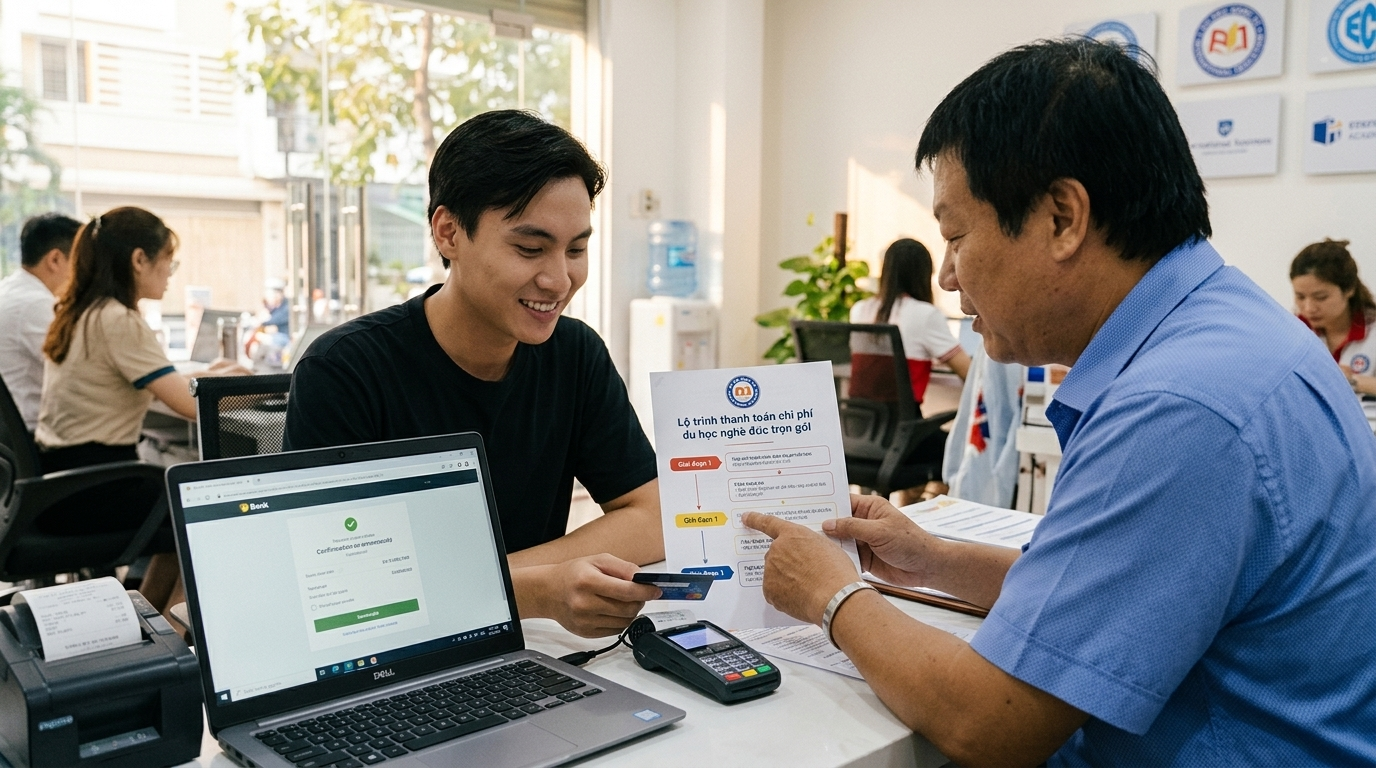
Stage 1: Signing the contract and learning German
At this stage, you will pay part of the service fee to begin processing your application. The registration fee B1 German language course will also be collected at this stage. You will receive a study plan and career guidance. The centre will begin preparing translations of your basic documents. You must provide complete copies of your original academic transcripts and qualifications.
Stage 2: Detailed document processing
Once you reach A2 or B1 proficiency, the centre will proceed with obtaining your contract. You will make the second payment when you receive the original contract from Germany. At this point, your application documents will be assembled in full for the visa application. You will also be required to deposit the funds into a blocked account during this stage. All steps must be properly coordinated in terms of timing.
- Pay the first instalment immediately after finalising your study-abroad plan.
- Take regular German language proficiency assessments.
- Complete the No. 2 criminal record certificate application.
- Pay the second instalment once you have received the employment contract.
- Open a blocked account and wait for confirmation of the money transfer.
- Pay the remaining balance once your visa has been successfully issued.
Stage 3: Receive Your Visa and Depart for Germany
The final payment is only collected once you have your visa in hand. You can then purchase your flight ticket and prepare your luggage. The centre will organise a detailed pre-departure briefing. It will also contact its team in Germany to arrange your airport pick-up. This support is designed to ensure your safety upon arrival.
Bảo, from Vũng Tàu, paid the final instalment six months after signing the contract. He was very satisfied because everything progressed according to the original commitments. Bảo travelled to Germany in autumn and was welcomed at Munich Airport. Trang, from Nam Định, experienced health problems and had to postpone her flight. As she had not yet paid the final instalment, she was able to defer her financial commitment easily. One year later, Trang resumed the programme without incurring any additional fees.
Build a Solid Financial Plan for a Smoother Vocational Study Journey in Germany
The total cost of vocational study in Germany is easier to manage when parents and students have a clear plan from the outset. Rather than focusing solely on the initial fees, it is more important to choose a transparent programme that minimises unexpected expenses and suits the family's financial circumstances.
A good financial plan should cover German language courses, document processing, a blocked account and initial living expenses in Germany. With proper preparation, students can take a more proactive approach to the visa application process and settle into life more quickly after arriving in Germany to study and work.
PDT EDUCATION is currently a preferred choice for many students and parents seeking a safe and cost-effective vocational study programme in Germany. With a clearly structured support pathway from language learning to departure, the centre aims to provide long-term guidance as students build stable careers in Germany.
>>> See other topics: 7 Comprehensive Steps to Settling in Germany: Is Vocational Study the Right Pathway?