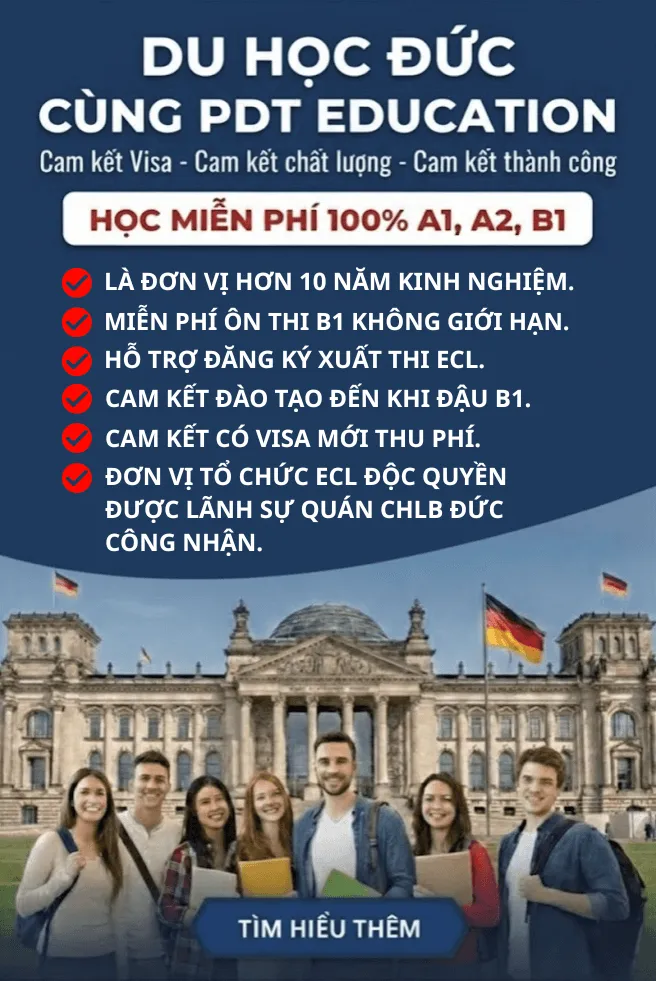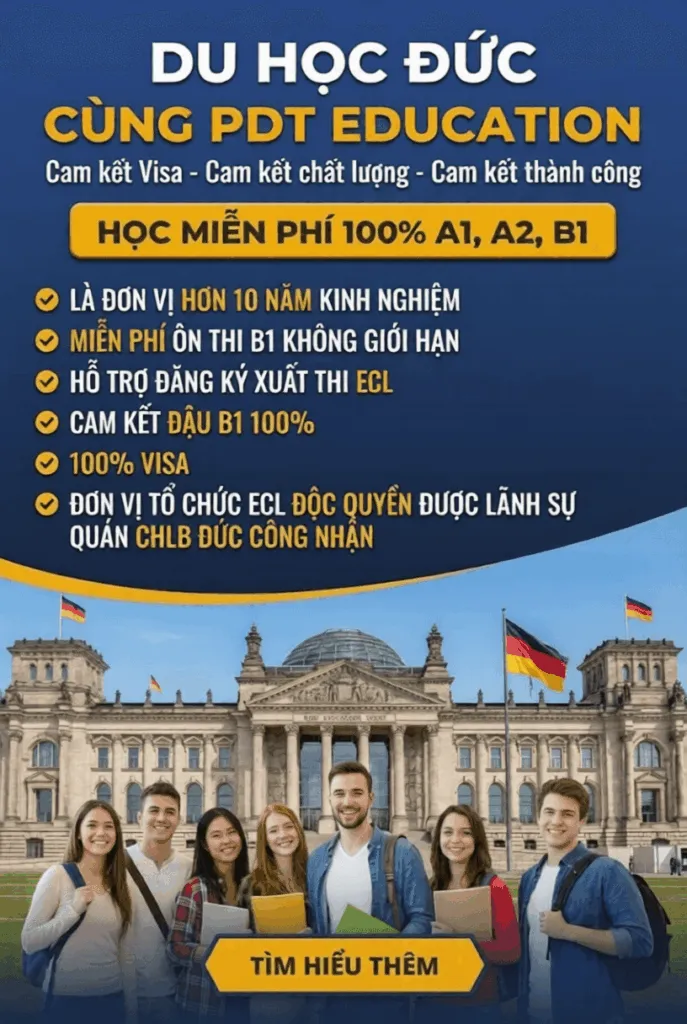


How much does it cost to study German from A1 to B1 in Ho Chi Minh City in 2026? This is one of the issues of greatest concern to students, parents, and people preparing for vocational training in Germany. With a structured training pathway, the total tuition for all three levels typically ranges from VND 30–50 million, depending on the center, learning format, and training duration. PDT Education currently lists a total tuition fee of VND 34 million for the three A1, A2, and B1 courses on its website, excluding international certificate exam fees and any additional expenses outside the program.
When researching German language course fees, to determine exactly how much does it cost to learn German, learners need to distinguish between tuition fees, exam preparation costs, certificate examination fees, and the budget for preparing a German vocational training application. The following article compiles German course prices for 2026, explains the factors affecting costs, and provides guidance on financial planning based on study and work goals in Germany.
Latest German Language Course Fees from A1 to B1 in Ho Chi Minh City in 2026

Overview of German language course fees for A1, A2, and B1 in Ho Chi Minh City
German language course fees in Ho Chi Minh City depend on the training provider and program structure. Courses with the same A1, A2, or B1 label do not necessarily have equivalent durations. Some centers divide each level into two modules, while others publish a price for the entire level. Therefore, learners should check what is included in the tuition fee before making comparisons.
For German language courses, according to the course prices published on the PDT Education website, the reference tuition fees for 2026 are as follows:
| Number of parts | Tuition published by PDT | In-person class duration | Training objectives |
|---|---|---|---|
| A1 | VND 9,000,000 | 11 weeks | Pronunciation, foundational grammar, and simple communication |
| A2 | VND 12,000,000 | 11 weeks | Communication in everyday situations |
| B1 | VND 13,000,000 | 11 weeks | Independent communication, expressing opinions, and preparing for certificate exams |
| A1–B1 total | VND 34,000,000 | 33 weeks according to the in-person class schedule | Complete the training program through B1 |
When planning a budget for German language courses, Note: This is the sum of PDT Education's individually listed tuition fees, not a guaranteed quote for a discounted A1–B1 package. Actual tuition, opening dates, payment terms, and promotional policies must be confirmed through an announcement or contract at the time of enrollment.
To optimize the value of German language course fees, reference sources: https://pdt.edu.vn/khoa-hoc/trinh-do-a1/ ; https://pdt.edu.vn/khoa-hoc/trinh-do-a2/ ; https://pdt.edu.vn/khoa-hoc/trinh-do-b1/ .
How much does it cost to learn German? Distinguishing course tuition, learning materials, and certificate exam fees
Based on German language training experience, when researching German course fees, many people focus only on course prices without accounting for expenses associated with international examinations. In practice, the budget should be divided into three separate categories.
- Tuition fees: Payment for the teaching program, instructors, classroom activities, assignments, and periodic assessments within the agreed scope.
- Textbook and learning material costs: These may include core textbooks, workbooks, online learning accounts, mock exams, and supplementary materials. Some centers include learning materials in the tuition fee.
- Certificate examination fees: Fees paid to organizations administering Goethe, ECL, or telc examinations. These fees are generally separate from the tuition charged by language centers.
For example, when researching German course fees, if a student completes three German courses with total tuition of VND 34 million and registers for the ECL B1 exam covering all four skills at the reference fee of VND 6 million, the initial study and exam budget is approximately VND 40 million, excluding supplementary lessons or retakes if needed.
German course prices depend on the learning format, class size, training duration, and learning outcomes
For German language courses, the price reflects more than just the number of lessons. A program with a longer duration, regular progress assessments, teacher feedback on written work, and communication practice in small groups may offer different value compared with a course focused primarily on delivering theory.
When planning a German language course budget, significant factors affecting tuition include whether classes are in person or online, class size, instructor experience, total lesson hours, exam preparation, and supplementary services. For students preparing for vocational training in Germany, interviews with German employers and communication skills for professional environments should also be considered.
To get the best value from German language course fees, parents should compare total lesson hours, actual class sizes, the level of support for each skill, and policies for repeating courses rather than simply asking how much a B1 course costs. These are important criteria for evaluating training costs relative to instructional time and learning outcomes.
Complete German Language Course Cost Table from A1 to B1 in Ho Chi Minh City

German A1 and A2 tuition: Curriculum, study duration, and estimated expenses
Based on German language training experience, the A1–A2 stage determines the quality of a learner's German language foundation. Students begin with pronunciation, sentence structures, verb conjugation, and grammatical gender, then develop their listening comprehension, letter writing, ability to describe experiences, and communication in familiar situations.
When researching German course fees, A1 students need to learn how to introduce themselves, use numbers and times, ask common questions, and form simple sentences. At A2, the curriculum expands to include past tenses, subordinate clauses, expressing needs, and handling common situations encountered when living in Germany.
For German language courses, the total tuition for A1 and A2 based on PDT Education's published fees is VND 21 million. Both levels are listed with an 11-week in-person schedule per course, five sessions per week, and three hours per session. The center also states that textbooks and learning materials are provided during the course.
When planning a German language course budget, learners should note that completing A2 does not automatically mean they receive an international A2 certificate. If the receiving program only requires a B1 certificate, students may allocate their budget to the B1 exam instead of registering for both A1 and A2 exams. However, this decision must be based on the actual requirements of the receiving organization and the applicable visa type.
German B1 course costs: Course tuition, exam preparation, and Goethe or ECL certificate examination fees
To optimize the value of German language course fees, German B1 course costs must be calculated based on both the goal of completing the level and the goal of obtaining a certificate. At B1, learners are expected to understand the main points of clear conversations on familiar topics, handle many practical situations, write coherent texts, and briefly explain their opinions.
Based on German language training experience, PDT Education lists B1 tuition at VND 13 million for the B1.1 and B1.2 program. If choosing a German B1 course for a vocational training application, students should check whether the program includes preparation for a specific exam format, mock tests, and individual error correction.
According to the ECL update published by PDT Education for 2026, the reference fee effective June 4, 2026, is VND 6,000,000 for the B1 exam covering all four skills and VND 1,700,000 for an individual skill under the applicable system. Applicants should verify the latest fee schedule and retake conditions with the examination center before paying.
German language course costs from A1 to B1: Calculating the total budget for a continuous learning pathway and a complete training package
To calculate German language course costs from A1 to B1, families should prepare a budget using the following formula: Total budget = A1 tuition + A2 tuition + B1 tuition + Required exam fees + Contingency for additional expenses.
Based on the tuition fees currently published by PDT Education, the following three financial scenarios can be developed:
| Category | Basic option | Option with supplementary lessons | Higher contingency option |
|---|---|---|---|
| A1–B1 tuition | VND 34,000,000 | VND 34,000,000 | VND 34,000,000 |
| ECL B1 exam covering all 4 skills | VND 6,000,000 | VND 6,000,000 | VND 6,000,000 |
| Supplementary lessons and additional exam preparation | VND 0 | VND 2,000,000 | VND 4,000,000 |
| Allowance for retakes, transportation, and additional learning materials | VND 0 | VND 2,000,000 | VND 5,000,000 |
| Illustrative total budget | VND 40,000,000 | VND 44,000,000 | VND 49,000,000 |
Additional costs to budget for beyond tuition: Textbooks, retakes, supplementary lessons, and certificate issuance fees
In addition to tuition, learners should set aside a contingency fund for textbooks not included in the program, specialized exam preparation materials, extra lessons for weaker skills, and retake fees. If the center has already provided the learning materials, the textbook cost should not be added to the budget a second time.
- Textbooks: Determine whether printed materials, digital licenses, and supplementary resources are included in the tuition fee.
- Retakes: Check the rules for retaining results, retaking individual skills, or retaking the entire exam under each examination system.
- Supplementary lessons: Register only when assessments reveal specific gaps in knowledge or skills.
- Certificates: Clarify whether the exam fee includes the initial certificate issuance. Reissuance, courier delivery, or additional verification may incur separate fees.
In particular, Goethe, ECL, and telc have different retake rules. Students should read the regulations applicable on the registration date and avoid assuming that all certificates allow results to be retained and combined in the same way.
Factors Affecting German Course Prices and the Total A1–B1 Budget

Comparing in-person German classes in Ho Chi Minh City, online learning, and guided self-study
No single learning format is the most cost-effective for everyone. In-person classes provide regular interaction, online learning reduces commuting time, and guided self-study suits people who can maintain strong discipline.
| Criteria | In-person learning | Online learning | Guided self-study |
|---|---|---|---|
| Cost | Based on class tuition and transportation costs | Based on the course package, generally reducing travel expenses | Flexible according to learning materials and the number of guidance sessions |
| Interaction | Directly with teachers and classmates | Through online classes | Depends on the schedule for communicating with the instructor |
| Speaking practice | Convenient for group activities | Effective when sufficient interaction time is available | May lack a communication environment |
| Progress monitoring | Easy to maintain a fixed study schedule | Requires personal discipline | Requires a high degree of self-motivation |
| Suitability | Beginners who need frequent interaction | Working people and those living far from the center | Learners who already have a foundation and self-study methods |
At PDT Education, published course information indicates that in-person and online programs have different class schedules and durations. Therefore, before switching learning formats, students should verify the actual instructional hours, tuition for each format, and the corresponding ability to meet the learning outcomes.
Choosing a standard course, an intensive course, or an exam preparation class based on initial proficiency
A standard course suits learners who want to build a solid language foundation and have time to review between lessons. An intensive course is suitable for learners who can dedicate many hours each week to acquiring knowledge and practicing independently. An exam preparation class is appropriate for those whose proficiency is close to B1 but who need to understand the exam format and test-taking strategies.
Do not assume that an intensive course is always more economical. If the pace exceeds a learner's ability to absorb the material, they may need to repeat the course or attend additional tutoring sessions, increasing the final cost.
For people who have studied German before, a placement test can help determine whether they can continue at A2 or B1 or join an exam preparation class. However, being placed in a higher-level class does not eliminate the need to address gaps in foundational knowledge.
How to Optimize German Learning Costs: Assess Initial Proficiency, Maintain Progress, and Minimize Retakes
To limit additional costs throughout the A1–B1 pathway, students should focus on learning effectively rather than simply trying to complete the course as quickly as possible.
- Take a placement test before enrolling if you already have some German knowledge.
- Assess listening, speaking, reading, and writing after each module to identify weaknesses.
- Maintain daily study and review habits, especially vocabulary and conversational reflexes.
- Take mock exams under time conditions similar to the actual examination.
- Register for the official exam only when assessments indicate that you are likely to meet the examination system's requirements.
- Verify promotional offers, scholarships, or repeat-course support in writing before making payment.
Based on PDT Education's training guidance, a continuous pathway from A1 to B1 helps learners track progress and prepare proactively for the exam preparation stage. However, the actual time needed to obtain a certificate depends on each individual's ability, attendance, and academic performance.
German A1 to B1 Learning Pathway and Appropriate Certificate Examination Costs
The A1–A2–B1 pathway under CEFR: Proficiency goals, study duration, and financial planning for each stage
The Common European Framework of Reference for Languages (CEFR) is used to describe language proficiency across six levels, from A1 to C2. It is an assessment framework, not a regulation requiring all centers to offer the same number of weeks or charge the same tuition at each level.
The German A1–B1 learning pathway can be structured into three stages with specific objectives:
| Stage | CEFR objectives | Published PDT in-person class duration | Tuition published by PDT |
|---|---|---|---|
| A1 | Understand and use familiar expressions and exchange basic personal information | 11 weeks | VND 9,000,000 |
| A2 | Communicate in simple situations and discuss work and daily life | 11 weeks | VND 12,000,000 |
| B1 | Understand the main points, communicate relatively independently, and describe experiences and opinions | 11 weeks | VND 13,000,000 |
| Total | Training from beginner level to B1 | 33 weeks according to the published class schedule | VND 34,000,000 |
The total of 33 weeks is the combined instructional period for the three in-person courses. It excludes breaks between courses, waiting time for examinations, and additional exam preparation. Online learners may need a longer schedule because their weekly study intensity differs.
To learn about the proficiency criteria for each level, consult the Council of Europe's resources at https://www.coe.int/en/web/common-european-framework-reference-languages .
Goethe-Zertifikat and ECL examination fees: Budgeting, choosing an exam, and verifying current prices
Exam fees are an important budget item when preparing for a B1 certificate. The following table compares options relevant to learners in Ho Chi Minh City in 2026.
| Certificate or examination | Reference fee for 2026 | Notes |
|---|---|---|
| ECL A2 | VND 5,500,000 for all 4 skills | According to the updated fee schedule published by PDT effective June 4, 2026 |
| ECL B1 | VND 6,000,000 for all 4 skills | Must be reconfirmed with the examination center |
| ECL B1 individual-skill examination | 1.700.000 VND/skill | Depends on current module examination rules and result-retention conditions |
| Goethe-Zertifikat B1 | According to the Goethe-Institut Ho Chi Minh City fee schedule on the registration date | Fees may differ for independent candidates, Goethe students, and different examination formats |
| telc Deutsch B1 | At an authorized examination center | Check the examination center, schedule, and published fees |
Note on fee updates: Some ECL examination information pages published before June 4, 2026, still show a B1 fee of VND 5,500,000 under the previous exam structure. When preparing a 2026 budget, use the more recent announcement and verify directly with the organizer before paying. The fees listed are not guaranteed fixed prices for every examination.
When is a separate exam preparation course necessary? Assess all four skills to avoid additional costs
Not every student who completes B1 needs to enroll in a separate exam preparation course. The decision should be based on proficiency assessment results and familiarity with the chosen examination format.
For listening, learners need to understand main ideas and details in conversations appropriate for B1. Reading requires identifying main ideas, purposes, and specific information in texts. Writing requires clarity, coherence, and reasonable grammatical accuracy. Speaking requires sustained communication, exchanging opinions, and responding appropriately to an interlocutor.
If only one or two skills are weak, students should prioritize targeted supplementary classes rather than automatically repeating the entire B1 course. Those enrolling in a German B1 course at a center should clarify how many mock exams are included and whether exam preparation is covered by tuition or charged separately.
ECL exam preparation should follow the latest regulations and assessment criteria. Passing cannot be guaranteed simply by attending a certain number of practice sessions. Results depend directly on the candidate's performance in the official examination.
Learning German from A1 to B1 for Vocational Training in Germany: Budget and Solutions at PDT Education
Determine German proficiency and language requirements based on the program, occupation, and requirements of the receiving organization in Germany
For people preparing for vocational training in Germany, learning German up to B1 is not merely a training milestone; it is also directly related to visa eligibility and the ability to study at a company or vocational school.
According to German Embassy visa regulations According to information published on the websites of German diplomatic missions in Vietnam, applicants for vocational training visas generally need to demonstrate German proficiency of at least B1. Accepted certificates include Goethe, telc, ÖSD, ECL, and TestDaF, subject to the relevant level requirements. The vocational training visa guidance also requires German certificates to have been issued no more than 12 months before the application date.
If applicants attend a German language course in Germany before starting vocational training, the language requirements may differ if they meet the applicable conditions and provide suitable supporting documents. This is an exception that must be checked against the specific visa regulations; it does not establish that all A2 applicants can obtain a vocational training visa.
In practice, German language requirements set by companies, vocational schools, or occupations may exceed B1. Fields requiring complex communication, especially healthcare, may require B2 or further German language development after arrival.
Official legal information: https://vietnam.diplo.de/vn-vi/dichvulanhsu/05-visaeinreise/2306816-2306816 .
Estimating the total cost of preparing a vocational training application: Language courses, certificate exams, translations, visas, and proof of financial resources when required
The budget for German courses from A1 to B1 and the budget for vocational training in Germany cover different expenses. After obtaining a suitable language certificate, applicants must also prepare personal documents, a training contract, educational documents, and other materials required by the relevant visa checklist.
| Category | Cost or budgeting method | Notes |
|---|---|---|
| German A1–B1 courses | VND 34,000,000 based on PDT's published tuition | Excludes B2 courses or additional supplementary lessons |
| ECL B1 certificate examination | Approximately VND 6,000,000 according to the updated reference fee schedule | Confirm the fee at the time of registration |
| Translation, notarization, and legalization when required | Depends on the number and type of documents and the service provider | Not all documents have the same certification requirements |
| German national visa | Usually EUR 75 for adults | Convert to VND according to payment instructions and check whether any fee exemptions or reductions apply |
| Application processing and related service fees | According to the official fee schedule of the receiving service provider | Distinguish mandatory fees from optional services |
| Financial proof | Based on the actual financial shortfall determined by the visa authorities | A blocked account or another accepted form of financial guarantee may be required |
| Airfare, insurance, and initial expenses | Depending on travel dates, destination, and actual needs | A separate contingency budget is recommended |
| Consulting and application processing services, if used | According to the service contract | Must be transparently quoted and distinguished from government fees |
About the Sperrkonto blocked account: This is a method of proving financial resources by depositing funds that are blocked and released according to specified limits. Not every vocational training applicant is required to open a blocked account with the same amount of money.
According to the 2026 vocational training visa guidance, for paid company-based vocational training programs, the reference amount for covering living expenses is EUR 1,048 per month before deductions or EUR 822 per month after deductions. If the allowance under the contract falls below the applicable threshold, applicants may need to prove additional financial resources to cover the difference. Thresholds for school-based training and other situations may differ.
Regarding APS: APS assessment primarily concerns academic pathways and certain categories of applications for university study in Germany under the applicable regulations. APS is not a default mandatory procedure for every applicant pursuing dual vocational training. If applicants switch to a university goal or a program requiring degree assessment, they should separately check APS rules, degree recognition requirements, and related procedures.
For vocational training applications, the decision to issue a visa rests with the German authorities. Having a B1 certificate, a training contract, or a consulting service does not guarantee visa approval. Applicants may be asked to provide additional documents and must follow the submission procedures published by the diplomatic mission at the time of application.
Vocational training benefits in Germany: Distinguishing tuition-free vocational training, training allowances, and actual living expenses
One of the main benefits of Germany's dual vocational training system, also known as duale Ausbildung, is that learners generally do not pay vocational training tuition under the model combining company-based training with a public vocational school, while also receiving a training allowance under their contract.
However, the claim 100% tuition-free vocational training in Germany must be understood within its proper scope: it applies to specific training programs that do not charge tuition. It does not mean that all vocational training institutions, private schools, or preparatory courses in Germany waive every cost.
For eligible programs, training allowances may range from EUR 1,000–1,400 per month before taxes and deductions, depending on the occupation, training year, region, employer, and collective labor agreement. This range is illustrative only and is not a guaranteed fixed allowance for every contract.
Partnering with PDT Education: Transparent German language learning pathways, personalized budget advice, and guidance for vocational training in Germany
For students aiming to pursue vocational training in Germany, choosing a suitable training provider should be based on teaching quality, tuition transparency, and the ability to provide application guidance. PDT Education aims to combine German language training from A1 to B1, international certificate exam preparation, and consultation on vocational training programs in Germany.
With more than 10 years of experience as presented by the organization, and the professional guidance of Mr. Phan Dinh Thu, founder and Vice Chairman of the Ho Chi Minh City Vietnam–Germany Friendship Association, PDT Education emphasizes a structured German learning pathway, practical communication skills, and planned financial preparation for students.
For ECL exam preparation, students should request information about the curriculum, assessment methods, actual results for each examination session, and the scope of support if they do not pass. Claims of high pass rates should be accompanied by verifiable data; previous students' results do not guarantee the results of future candidates.
When enrolling in a vocational training program, families should request a contract that specifies German tuition, service fees, payment schedules, additional expenses, each party's responsibilities, refund policies, and service delivery conditions. Benefits such as tuition-free vocational training, training allowances, job placements, and accommodation support should be verified against actual documents or contracts from the German side.
Conclusion
German language course fees from A1 to B1 in Ho Chi Minh City in 2026 should be calculated by including tuition, certificate examination fees, and a contingency budget. According to PDT Education's published price list, total tuition for the three A1–B1 courses is VND 34 million. If taking the ECL B1 exam covering all four skills at the reference fee of VND 6 million, the estimated total study and exam budget is approximately VND 40 million, excluding other additional expenses.
To develop a suitable learning pathway, learners should identify their intended use of the certificate, check the receiving organization's requirements, and update costs at the time of registration. If you plan to take the ECL B1 exam in Ho Chi Minh City, you can contact PDT Education to learn about exam dates, fees, and German A1–B1 courses.
Explore courses and get advice at PDT Education: https://pdt.edu.vn/