

The journey of converting your nursing qualifications for Germany is an important step towards opening up employment opportunities and long-term settlement in Europe. However, this process requires thorough preparation in terms of documentation, language skills and professional knowledge. Germany currently faces a shortage of hundreds of thousands of healthcare workers every year, particularly in elderly care nursing and clinical nursing.
From 2026, the German government will continue to expand its policies for attracting skilled workers through the new Skilled Immigration Act. This gives international nurses more opportunities to move to Germany to study, work and build a sustainable career. However, nursing qualifications obtained in Vietnam are generally not recognised as fully equivalent from the outset. Therefore, understanding the nursing qualification recognition process in Germany will help you save time and money while minimising the risk of problems with your application.
The following article will guide you through each stage of qualification assessment, explain how to prepare your documents in accordance with German requirements, and share the most effective ways to manage your application.
Overview of the Nursing Qualification Recognition System in Germany
Germany's qualification recognition system is highly structured. Each federal state has its own authority responsible for receiving applications. The authority will compare your training programme with German standards and identify any differences in theoretical and practical training.

Why Is the Assessment Process So Strict?
Nursing in Germany directly involves people's lives. Therefore, medical safety standards are given the highest priority. From 2026, Germany will apply a generalist nursing model, which differs from Vietnam's specialist nursing system. These differences make the comparison of training programmes more complex.
Essential Requirements to Get Started
You must hold a bachelor's degree or college diploma in nursing from Vietnam. A detailed academic transcript clearly showing the number of theoretical and practical training hours is compulsory. In addition, you need at least a B1-level German language certificate. This certificate must be issued by the Goethe-Institut or telc . Good health and a clean criminal record are also compulsory requirements.
The Overall Pathway from Vietnam to Europe
This journey is divided into several consecutive stages. Planning each stage in detail will help you save time and money.
- Pass the B1-level German language examination in Vietnam.
- Prepare, translate and have all documents legally certified.
- Submit the application to the relevant state authority in Germany for assessment.
- Receive notification of the outcome of the qualification equivalence assessment.
- Apply for a visa to travel to Germany to undertake additional training.
- Complete the training course or pass the professional examination.
- Receive the official professional licence (Urkunde) in Germany.
Nguyen Thi Lan in Munich spent 8 months on this stage. She encountered difficulties because her transcript did not include the required number of paediatric practical training hours. Tran Van Minh in Berlin was more thorough. He requested confirmation of his working hours from his former hospital. As a result, his application was processed 2 months faster.
Practical tip: Request a detailed certificate showing the number of clinical placement hours from your college or university straight away. Do not submit only a general transcript.
Core Requirement Required details Level of importance Graduation certificate Original and certified translation Required Detailed academic transcript Clearly distinguish between theoretical and practical hours Assessment decision German language certificate Level B1 or B2 Required Judicial record Form No. 2, issued within the last 3 months Required Medical certificate According to the embassy's standard format Required
Detailed Steps for the Recognition of German Nursing Qualifications
Process recognition of German nursing qualifications is the most important step. If you make a mistake, you may have to wait several additional months. The relevant authorities follow very strict procedures. All documents must comply with the prescribed standards.
Stage 1: Collecting and Translating Documents
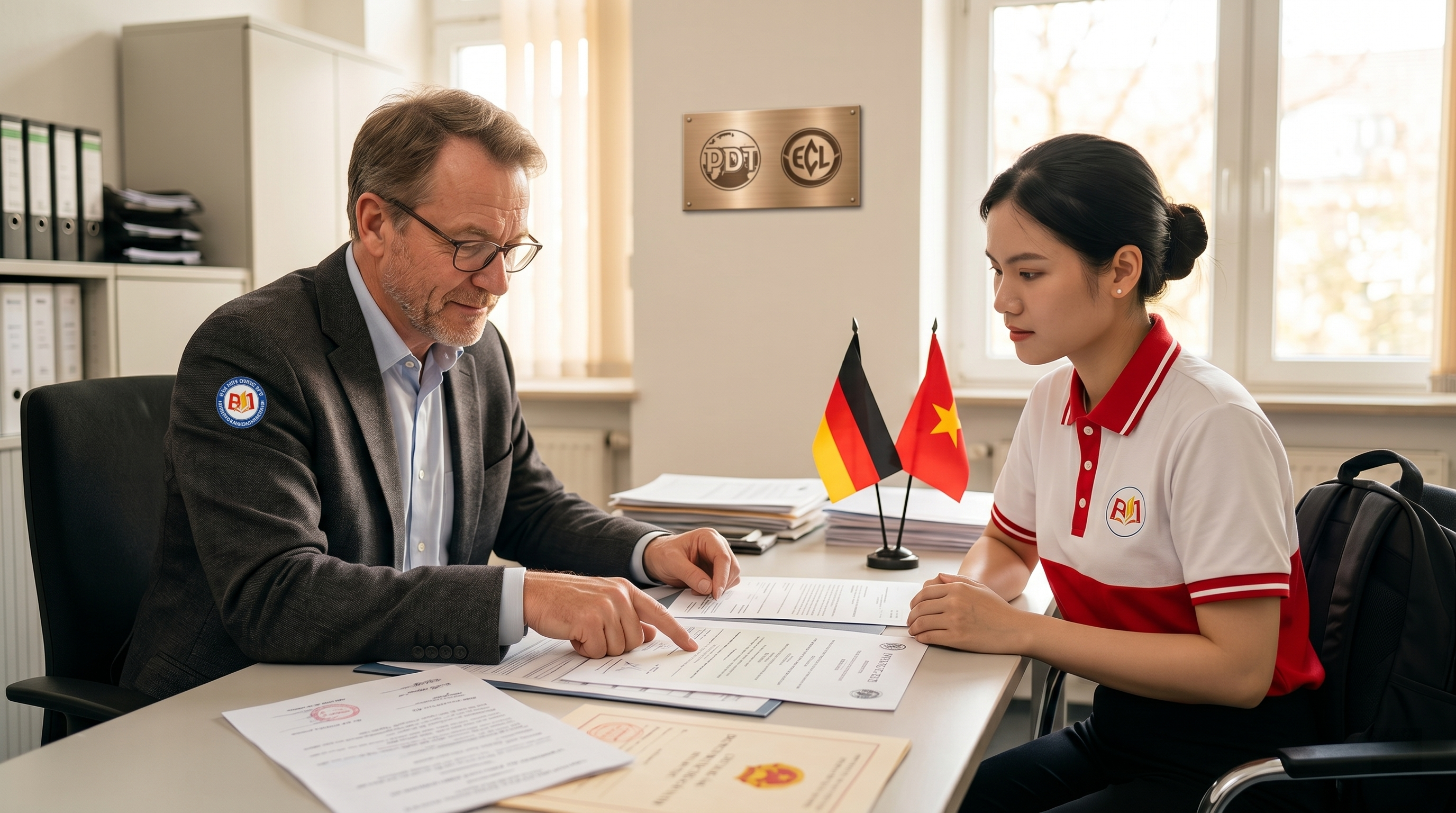
You must gather all relevant qualifications and certificates. Documents proving your work experience are also very important. All documents must be legalised by the German Embassy. They must then be translated into German by a sworn translator.
Stage 2: Submitting Your Application to the State Authority
Each federal state in Germany has its own healthcare regulations. You must submit your application in the state where you intend to work. Applications are usually submitted by post or through an online portal. The assessment fee will then need to be paid.
Stage 3: Reviewing the Results and Planning the Next Steps
The relevant authority will need several months to assess your application. It will compare your training programme with the German training requirements. The results will be sent to you by post. Based on PDT EDUCATION's experience, more than 90% of applications from Vietnam show differences in training. You should be prepared to undertake additional training.
- A copy of a valid passport or identity card.
- A CV written in German (Europass format).
- Degree certificate and academic transcript, duly legalised.
- Professional practising licence in Vietnam (if available).
- German language certificate at B1 level or above.
- Employment contract or invitation letter from the nursing home.
Ms Le Thi Hoa in Frankfurt once had her application rejected. She used an ordinary translation instead of a sworn translation. Mr Pham Tuan in Hamburg, on the other hand, forgot to submit his previous employment contract. He had to send it separately and wait another six weeks. Attention to detail is the key to success.
Practical tip: Always keep the parcel tracking number when sending documents to Germany. Check your email regularly so that you can respond promptly to requests for additional documents.
Document Type Processing method Place of processing Professional qualifications Consular legalisation German Embassy German translation Sworn translation Accredited translator Certificate of work experience Obtain the company's red stamp Previous workplace Curriculum vitae Type up in accordance with German standards Prepare independently
Understanding the Outcome: Deficit Notice (Defizitbescheid)
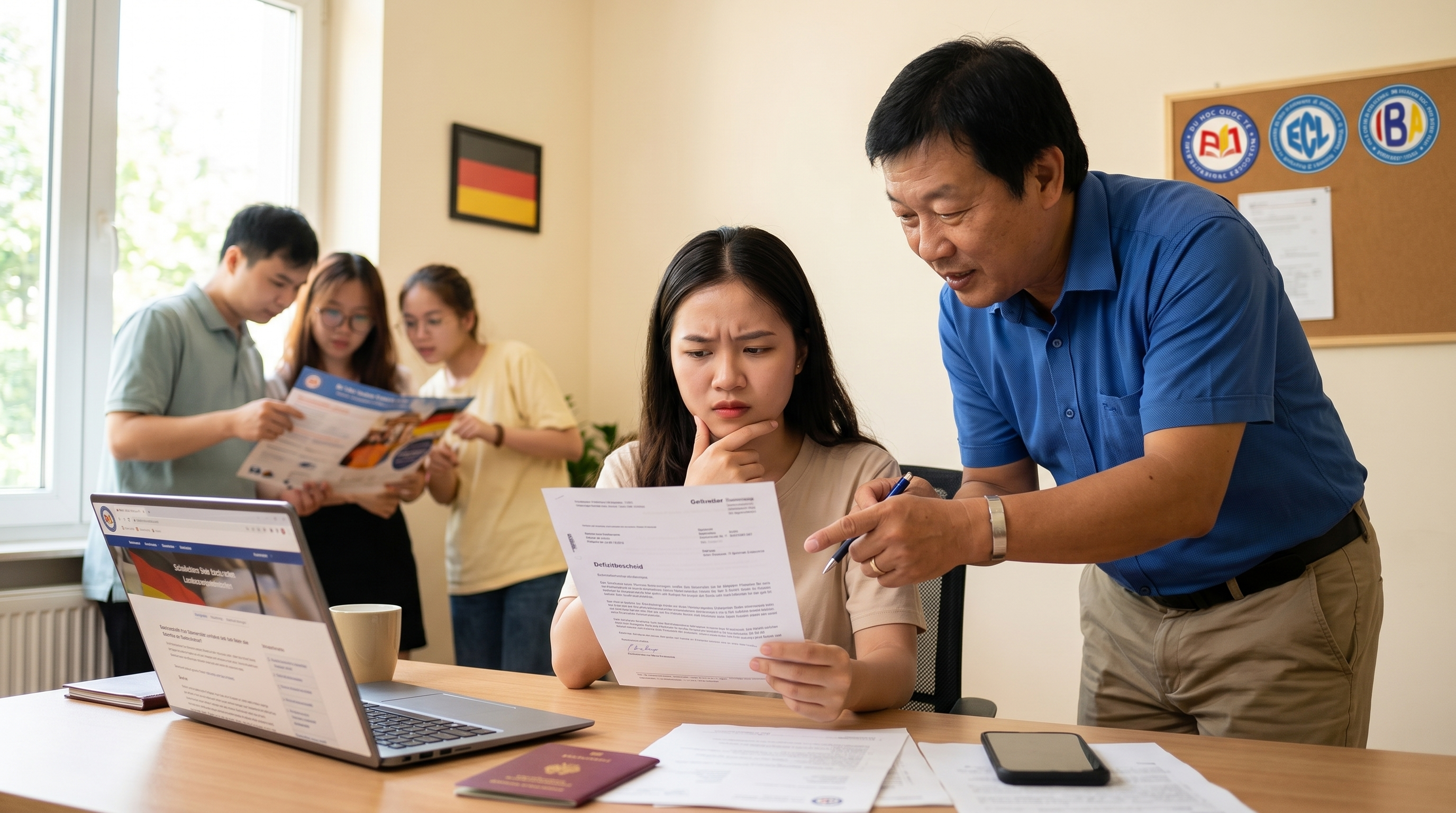
After a period of waiting, you will receive an important document. This document is called a Defizitbescheid. It determines the next steps in your journey in Germany. It is the key to applying for an entry visa.
What Does Full Recognition of Your Qualification Mean?
This is a rare occurrence for qualifications obtained outside Europe. If your qualification is fully recognised, you can start working immediately. You do not need to undertake any further training or examinations in your professional field. However, this is almost never the case with Vietnamese qualifications.
The True Meaning of the Deficit Notice
The Defizitbescheid lists in detail the subjects and areas of study in which you have gaps. It identifies the differences in theoretical and clinical practical training hours. The document also specifies the number of additional training hours you need to complete. Thanks to this notice, the nursing home can draw up a training plan for you.
Waiting Times and Administrative Fees
The assessment process usually takes between 3 and 6 months. Fees range from 200 to 600 euros, depending on the federal state. You are responsible for paying these fees yourself. Some employers may help cover the assessment costs.
- Assessment of Basic Nursing Theory.
- Practical Assessment in Elderly Care.
- Practical Assessment in Paediatrics and Psychiatry.
- Requirements for Additional Specialist Theoretical Training Hours.
- Requirements for Mandatory Clinical Placement Hours.
- Recommendation to Choose Between a Knowledge Examination and a Training Course.
Ms Vũ Thị Oanh in Stuttgart received a notice stating that she was 400 hours short of the required training. She focused on a placement in the maternity ward to make up the shortfall. Mr Hoàng Văn Nam in Bremen received his assessment result after four months. The notice indicated that he lacked substantial knowledge of German healthcare law. He has enrolled in an advanced theoretical training course.
Practical tip: Read the Defizitbescheid (deficiency notice) carefully together with your employer. They can help you enrol in the most suitable supplementary course.
Assessment level Practical implications Next steps Full recognition Fully equivalent qualification Obtain your licence to practise immediately Partially Recognized Gaps in certain areas of knowledge Complete supplementary training or take an examination Recognition refused Substantial differences Start the training again from scratch
Compensation Measures for Nursing Qualification Recognition in Germany
To complete the process of recognising your nursing qualification in Germany, you must address the identified gaps. The German government offers two main options. Both pathways lead to a licence to practise. The decision depends on your abilities and preferences.
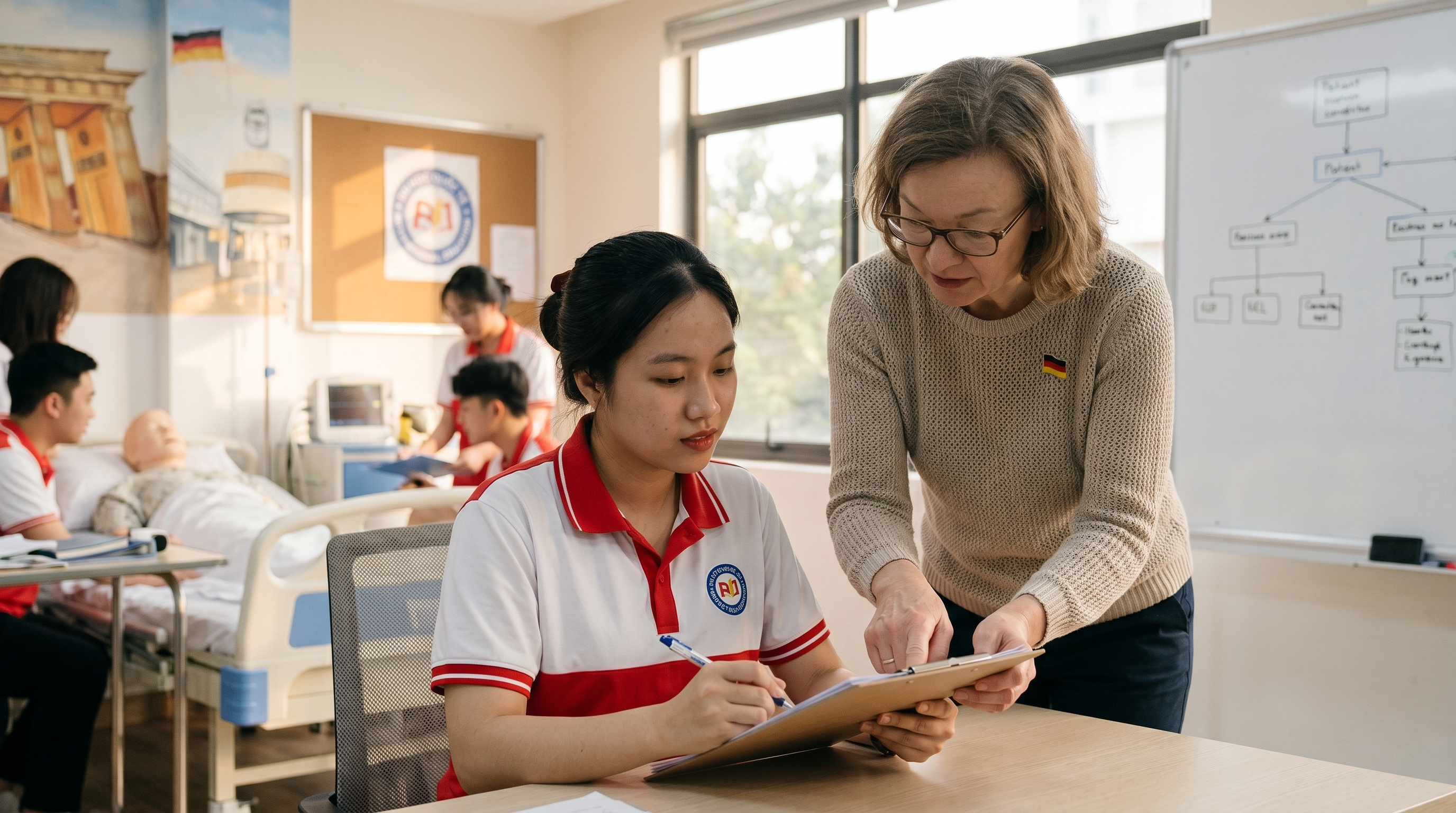
Professional adaptation course (Anpassungslehrgang)
This is the most popular route for Vietnamese professionals. You will attend a course lasting between 6 and 12 months. You will study theory while also completing practical training at a hospital. This course helps you become familiar with the actual working environment.
Medical knowledge assessment examination (Kenntnisprüfung)
If you are confident in your knowledge, you can choose to take the examination. It consists of both an oral and a practical component. No preparatory course is compulsory before the examination. However, the failure rate is relatively high due to language barriers.
Expert advice on choosing the right option
Experts at PDT EDUCATION recommend choosing the adaptation course. It offers greater security and peace of mind. You receive a salary throughout your practical training. The examination is only suitable for those with excellent German language skills.
The importance of specialised German at B2 level
B2-level German is a mandatory requirement for obtaining a professional licence. You must be able to communicate fluently with doctors and patients. Understanding medical records is an essential skill. Continue improving your language skills throughout the adaptation course.
- Become familiar with German workplace culture.
- Earn a stable income during your practical training.
- Build relationships with local colleagues.
- Reduce psychological pressure compared with sitting a major examination.
- Receive dedicated guidance from the head nurse.
- Improve your specialised German language skills in the healthcare field.
Mai Linh in Leipzig chose an 8-month adaptation course. She studied while earning a salary of €1,200 per month. Thu Thao in Dresden decided to take the oral examination instead. She became nervous and failed on her first attempt. She needed an additional three months of revision before finally passing.
Practical tip: Make a habit of noting down medical terminology every day at work. A small notebook in your lab coat pocket could be a lifesaver.
Comparison criteria Conversion course Knowledge examination Completion time 6 to 12 months You can take the exam immediately if you are ready Level of risk Low, with guidance and mentoring High, with a significant risk of failing due to weak German language skills Income Receive a salary during the internship No salary if you are only preparing for the exam Psychological pressure Low, with gradual adaptation High, as everything depends on a single exam day
Common Mistakes and Tips for Handling Applications
This journey is full of administrative pitfalls. Even a minor mistake can delay the process by several months. You need to understand the common errors to avoid repeating them. Careful preparation will determine whether your application succeeds or fails.

Translation and legalisation errors
Many applicants translate their own documents to save money. This is a serious mistake. German authorities only accept translations produced by authorised translators. Errors in medical terminology can also negatively affect the assessment of your application.
Insufficient evidence of practical training hours
Vietnamese academic transcripts often combine theoretical and practical training hours. German authorities require a clear breakdown for each specialism. You need to obtain a separate confirmation letter from your university to provide evidence. Without it, they will automatically consider your training hours insufficient.
An optimisation strategy with expert support
Working with PDT EDUCATION will help you avoid these risks. The centre will review every page of your documents. You will receive detailed guidance on contacting your former university to obtain the necessary paperwork. Your entire application pathway will be optimised.
- Do not use ordinary notarised translations issued by your local ward or commune authorities.
- You must obtain a detailed certificate confirming your work experience.
- Never forge any documents or certificates under any circumstances.
- All pages of your academic transcript must bear an overlapping official stamp.
- Make photocopies of all your documents for your records before sending them by post.
- You must pay the assessment fee by the deadline and keep the receipt.
Lê Dũng in Hannover once had his application returned because it was missing the university rector's signature. He had to send the documents back to Vietnam to have them corrected. Trần Việt in Nuremberg, meanwhile, had an issue with the translation of his pharmacology coursework. He had to spend an additional €200 to have a professional translator correct it.
Practical tip: Create an Excel checklist. Tick off each document once it has been translated, notarised and scanned into a PDF file.
Common Error Consequences How to prevent Incorrect translation of terminology Being considered insufficiently knowledgeable Hire a sworn medical translator Insufficient practical training hours Having to make up too many months of training Request a detailed confirmation letter from the university Failing to submit the fee receipt Application put on hold without being reviewed Attach proof of bank transfer Illegitimate qualification Permanently rejected Complete consular legalisation
To perform well on recognising your nursing qualification in Germany, you need a smart strategy. This process requires absolute attention to detail. Your German language studies must also progress in parallel. Do not let administrative procedures discourage you.
- You must prepare the clearest and most transparent application possible.
- Obtain a detailed certificate of practical training from the educational institution.
- Always use certified German-standard sworn translation services.
- Choose a bridging course to minimise risks.
- Invest heavily in specialised German language training at B2 level.
- Understand the meaning of the Defizitbescheid notice.
Each stage has its own strict requirements. However, the reward is a sustainable career. You will have the opportunity to work in one of the most modern healthcare environments. If you are looking for a vocational nursing study programme abroad with a reputable provider, get in touch today. PDT EDUCATION is always ready to accompany you on your journey towards achieving your European dream.
Building a Sustainable Nursing Career in Germany
The process of transferring your nursing qualifications to Germany is not merely an administrative procedure; it is also an important stepping stone towards a long-term career in Europe. Once your qualifications have been recognised and you have received your official professional licence, you will have the opportunity to work in a modern healthcare environment, with a stable income and a clear pathway to permanent residency.
To make this journey smoother, you need to prepare your documents, German language skills and professional knowledge thoroughly from the outset. A well-planned pathway will help you reduce pressure, save time and adapt confidently to your new life in Germany.
PDT EDUCATION is currently supporting many students throughout the process of transferring their nursing qualifications to Germany. Drawing on its experience in document preparation, German language training and specialised career guidance, PDT EDUCATION aims to help students build a sustainable professional foundation and develop their careers in the Federal Republic of Germany over the long term.
>>> See more here.