

Opening a new career path, working in Germany is becoming an attractive choice for many young Vietnamese thanks to stable income and a professional working environment. Not only providing opportunities to improve skills and accumulate international experience, this journey also helps you build a solid financial foundation and expand your long-term future. However, to succeed, understanding the conditions, the roadmap, and preparing carefully from the beginning are extremely important factors. This article will reveal the most realistic vocational training roadmap and settlement opportunities.
Overview of Labor Trends in Germany in 2026

The trend of working in Germany in 2026 continues to increase sharply due to high human resource demand.
The European job market is undergoing many major fluctuations. An aging population is causing this country a severe shortage of personnel. Many large enterprises have to scale down production.
This is a golden opportunity for Vietnamese youth. According to the 2026 European labor market report, recruitment demand is skyrocketing. The German government has enacted many open-door policies.
>>>See more: Labor Export to Germany: 5 Standard Steps to Open the Way for Employment and Settlement
The reality of personnel shortages in Germany
Germany is facing an unprecedented personnel problem. The local workforce is not enough to meet development needs. Key industries are hungry for high-skilled human resources.
Recruiting foreigners has become a national strategy. Immigrant labor in Germany plays an important role in maintaining the economy. Visa policies are being significantly relaxed.
Dual benefits from the vocational training model
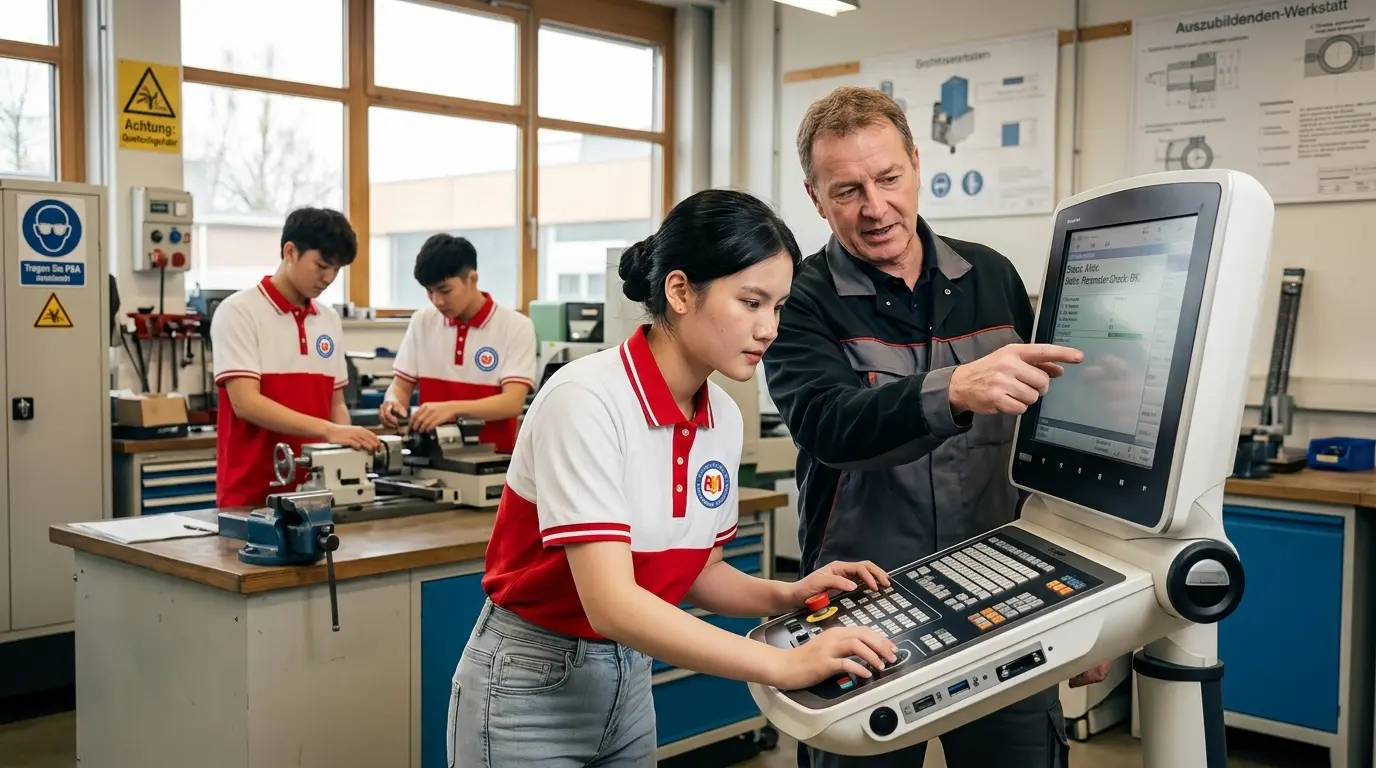
Vocational training brings superior benefits compared to other forms. Students are completely exempt from specialized tuition fees. You both learn theory and practice at the enterprise.
Monthly allowance helps cover living expenses. This is a safe way to work in Germany. Graduates have jobs immediately.
Comparison between vocational training and traditional labor export
Many people still confuse these two forms. Labor export is often seasonal and has few promotion opportunities. Vocational training grants international degrees and has a clear settlement path.
Choosing the right model determines your future. PDT EDUCATION experts always encourage a methodical vocational training path.
| Criteria | Vocational Training in Germany | Labor Export |
|---|---|---|
| Qualifications | European standard vocational degree | No professional certificate |
| Study costs | 100% Free | Must pay entirely by oneself |
| Opportunity for settlement | Very high (after 3-5 years of work) | Almost no opportunity |
| Initial income | Receive practical allowance | Basic salary according to contract |
- Free specialized training throughout 3 years of study.
- Receive practical salary right from the first month.
- Degrees have recognition value across Europe.
- Guaranteed 100% job placement in the right major.
- Safe, civilized, and equal working environment.
- Opportunity for permanent residency and citizenship.
Conditions for Working in Germany via Vocational Training

To begin this journey, you need to meet some strict standards. Careful preparation of the application is the decisive factor. The Consulate reviews visa very strictly based on actual capacity.
You should not be subjective in any stage. The companionship of reputable consulting units will help you avoid mistakes.
Age and educational qualification requirements
The program usually prioritizes candidates from 18 to 28 years old. Some specific industries may extend the age to 35. A mandatory requirement is high school graduation in Vietnam.
High school transcripts do not need to be too excellent but must be average-good. Those who already have a college or university degree will have a great advantage when interviewing for a visa.
German language standards B1/B2
Language is the most important key when working in Germany. You are required to achieve a B1 German certificate before flying. The language learning process usually lasts from eight to twelve months.
Upon arriving in Germany, you will continue studying to the B2 level. Participating in an intensive German language training program from the beginning is essential.
Health standards and criminal record
All candidates must undergo a strict general health examination. You must not have dangerous infectious diseases. Hepatitis B or tuberculosis can be a major barrier.
In addition, your criminal record must be completely clean. A certificate of no criminal record is a mandatory document in the visa application file.
- High school diploma and original transcripts.
- German B1 certificate (Goethe, TELC, or ÖSD).
- Passport valid for at least two years.
- Health certificate according to European standards.
- Criminal Record Certificate No. 1 issued in Vietnam.
- ID photos with white background taken according to international standards.
High-Paying Recruitment Sectors in Germany

The job market here is very diverse, but not every industry is suitable for Vietnamese people. Choosing the right major will determine your future income. You should consider based on personal interests and capacity.
According to research from PDT EDUCATION, some industry groups are always in a state of thirst for manpower. Below are the top choices.
Healthcare and Nursing sector
This is the industry with the highest recruitment demand today. Hospitals and nursing homes are always severely short of personnel. The apprenticeship allowance in this industry is also the highest.
However, the work requires good health and high patience. German workers in the medical industry are always especially respected by society.
Restaurant and Hotel Services sector
Tourism and services are the strengths of the European economy. The restaurant and hotel industry provides a dynamic working environment. You have many opportunities to communicate and improve your foreign language skills.
Living costs are often partially supported by the workplace. Opportunities for promotion to management levels are very clear if you work hard.
Engineering and Electro-mechanics sector
Germany is the cradle of the automotive and machinery manufacturing industry. The engineering group always brings extremely attractive salaries. The training program focuses on practice on modern assembly lines.
Men are particularly suited for the direction of working in Germany in this field. The career future is very solid.
Construction and Information Technology sector
The construction industry is booming due to infrastructure development needs. Bricklayers and refrigeration technicians are being recruited en masse. Besides, information technology is also a high-potential field.
Even if not part of the traditional vocational training system, IT is still a wide-open door. Vietnamese programmers are very welcome here.
| Industry Group | Apprenticeship allowance (Euro/month) | Starting salary (Euro/month) |
|---|---|---|
| Nursing and Healthcare | 1,000 – 1,300 | 2,800 – 3,500 |
| Restaurant – Hotel | 800 – 1,100 | 2,200 – 2,600 |
| Mechanics and Engineering | 900 – 1,200 | 2,700 – 3,200 |
| Construction | 850 – 1,150 | 2,500 – 3,000 |
- Effective communication and teamwork skills.
- Ability to adapt to high work pressure.
- Strict discipline and time compliance.
- Meticulousness and care in every small action.
- Spirit of learning and continuously updating knowledge.
Income and Costs When Working in Germany

Finance is always the top concern. The vocational training model helps you reduce the economic burden on your family. However, managing personal spending is very important.
The standard of living in big cities is quite expensive. You need to make a clear financial plan so as not to be under pressure. Income and costs vary by region.
Apprenticeship allowance during training
During the three years of study, you will receive a monthly allowance. This amount ranges from 800 to 1,300 Euro depending on the profession.
The allowance will increase gradually through each academic year. This is the main source of income to help you pay for rent and food. Compared to other countries, students in Germany have a very large financial advantage.
Official basic salary after graduation
After receiving your degree, you become an official German worker. The starting salary is usually from 2,400 to 3,.
500 Euro before tax. This salary depends on the industry and company size. You can completely negotiate your salary after one or two years of working.
Income increases steadily according to accumulated experience.
Analysis of realistic monthly living costs
The largest cost is usually the rent for accommodation. Sharing an apartment will save the budget significantly. Food costs and health insurance also take up a fixed amount.
According to the latest consumer price index in Germany, inflation has been well controlled. Students can completely have a surplus if they know how to spend.
| Cost Category | Small city (Euro) | Large city (Euro) |
|---|---|---|
| Rent (Shared room) | 300 – 450 | 500 – 700 |
| Basic food costs | 150 – 200 | 200 – 300 |
| Insurance and services | 120 – 150 | 120 – 150 |
| Travel and entertainment | 50 – 100 | 80 – 150 |
- Cook at home instead of going to expensive restaurants.
- Use monthly travel passes specifically for students.
- Shop at discount supermarkets like Aldi or Lidl.
- Rent housing in suburban areas to reduce costs.
- Find roommates to share monthly utility bills.
Settlement Path for Official Workers in Germany

The ultimate goal for many is to obtain a permanent residence card. Germany has a fairly open immigration policy for workers. This process requires patience and strict compliance with the law.
Paying taxes in full is a prerequisite. The team PDT Education always advises carefully on this roadmap from the beginning.
Conditions for applying for a long-term residence permit
After graduation, you have the right to extend your visa to find a job. Once you have worked and paid taxes continuously for two to three years, you can apply for a Blue Card. A long-term residence card allows you to work freely without depending on your old company.
This is the most important milestone when working in Germany. You need to prove a stable income.
Process for applying for German citizenship
If living legally for six to eight years, you have the right to apply for citizenship. The German government recently allowed dual citizenship. You must pass an integration test and achieve a B1/B2 German certificate.
The citizenship application review process usually lasts from a few months to a year. Having no criminal record is a prerequisite.
Rights to sponsor relatives for family reunification
After having a stable job, you have the right to sponsor your spouse and children. Sponsored persons have equal rights to study and work. German workers must prove they have enough housing space for the family.
The income level must also ensure the maintenance of the members. Children will enjoy a completely free education.
- Sign an indefinite labor contract with the enterprise.
- Pay full pension insurance according to legal regulations.
- Ensure no violations of the law during the period of residence.
- Pass the test assessing knowledge about Germany.
- Prove standard housing area for the family.
Overall, the decision to work in Germany through the vocational training route is a smart choice. This journey requires continuous effort to learn from foreign languages to professional skills. Becoming a high-skilled German worker will open up opportunities for a real life change.
You need to prepare carefully starting today.
- Master the German language path from A1 to B1 level.
- Choose a major suitable for your health and capacity.
- Prepare legal documents with absolute accuracy.
- Make a clear financial plan for the initial difficult stage.
- Maintain a serious attitude and comply with discipline at the workplace.
- Pay taxes in full for favorable long-term settlement applications.
If you are ready to create your future in Europe, do not hesitate to step out of your comfort zone. Contact consulting experts now to have an effective personalized roadmap mapped out!