Are you looking to work and settle legally in Germany but unsure about the degree recognition process? In reality, many international workers, despite having strong professional qualifications, still face obstacles simply because they lack a valid certificate of recognition from the examination authority.
Against the backdrop of Germany's severe shortage of highly skilled workers, obtaining a certificate of equivalence not only helps you expand your employment opportunities but also ensures that you receive the appropriate salary and have a pathway towards long-term residence.
This article will help you understand the entire degree recognition process through the examination authority, from eligibility requirements and procedures to optimisation strategies that can shorten processing times and increase your chances of success.
Understanding the Examination Board Qualification Recognition Process
The Role of Professional Accreditation Bodies
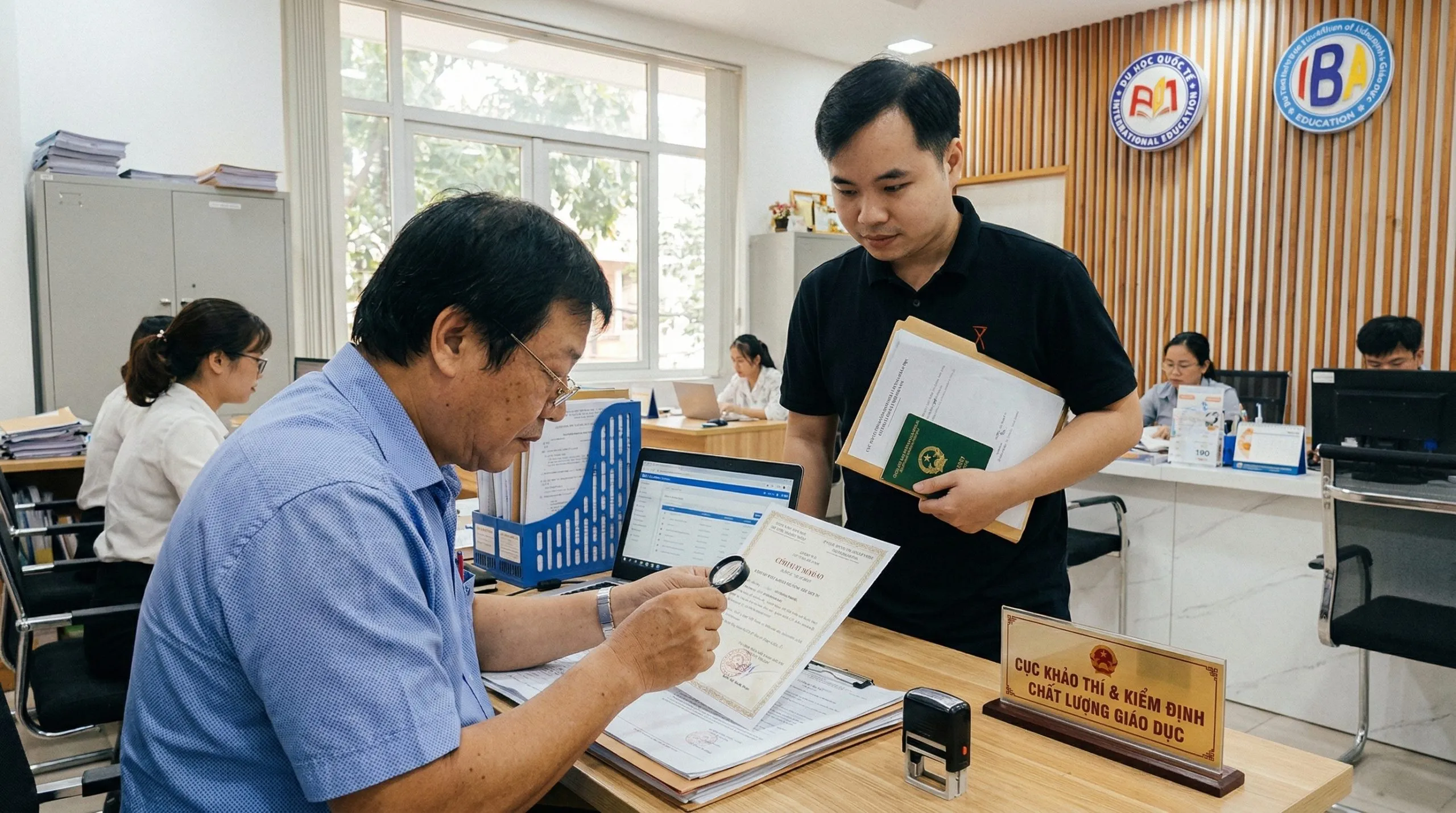
In Germany, the dual vocational training system is strictly regulated by professional associations. To ensure the quality of foreign workers, all qualifications must undergo a process of degree recognition by the examination authority. These bodies, such as the Chambers of Industry and Commerce (IHK) and the Chambers of Skilled Crafts (HWK), are responsible for assessing students' practical competencies as objectively as possible.
Classification of Certification Systems by Industry Sector
Depending on your field of study, the authority responsible for issuing the degree recognition certificate from the examination authority will vary. For example, the hospitality, hotel management and commercial services sectors are specifically regulated by the IHK. Meanwhile, mechanical engineering, construction and skilled crafts fall under the assessment jurisdiction of the HWK.
Understanding this classification will help you submit your application to the correct authority as required, saving you a considerable amount of waiting time.
The Difference Between Full and Partial Recognition
The results of the qualification recognition assessment by the examination authority are generally divided into two main categories: full recognition and partial recognition. Full recognition means that your qualification is considered 100% equivalent to German professional standards. In contrast, partial recognition requires you to complete additional courses or undertake further practical training to make up for any missing skills before being awarded full recognition.
List of common application-receiving authorities:
- Chamber of Industry and Commerce (IHK) FOSA in Nuremberg.
- Regional Chambers of Skilled Crafts (HWK) in the respective federal states.
- State Health Authorities for nursing and healthcare professions.
- Specialised regional Agricultural and Forestry Authorities.
- State Ministries of Education for early childhood education professions.
Real-life Example 1: Mai Le mistakenly submitted her mechanical engineering application to the IHK instead of the HWK, resulting in a delay of more than three months compared with the original expected processing time.
Real-life Example 2: Tuan Anh sought help in identifying the correct authority responsible for the restaurant industry from the outset and received his equivalence assessment result just four weeks after submitting his application.
| Assessing Authority | Regulated Industry | Review Time | Level of Difficulty |
|---|---|---|---|
| IHK FOSA | Economics, Trade, IT | 2 – 4 months | High |
| HWK | Crafts, Mechanical Engineering, Construction | 1 – 3 months | Medium |
| State Department of Health | Nursing, Medical Practitioners, Pharmacy | 2–5 months | Very high |
| Ministry of Education | Teachers, Education | 3 – 6 months | High |
Requirements for Examination Board Qualification Certification

Academic and Practical Training Requirements
To obtain certification of your qualifications from the examination authority, applicants must provide complete academic transcripts and practical training logbooks. The assessment body will compare the duration of your training against German framework standards very rigorously. Any shortfall in the number of specialist training hours must be clearly explained to avoid rejection.
Industry-Specific Language Proficiency Requirements
Language proficiency is always the biggest obstacle when applying for qualification equivalence assessments. Most professions require a German B1 or B2 certificate. According to statistical reports on shortages in the healthcare workforce in 2026, applicants with a B2 certificate will be given priority by hospitals and have their applications processed much more quickly than those with B1.
Practical Work Experience Requirements
Work experience plays a crucial role in helping you compensate for gaps in your theoretical training. A clear employment reference bearing the official stamp of your former employer will strengthen your application for qualification recognition by the examination authority. Applicants with more than three years of practical experience generally find it easier to obtain full recognition.
Mandatory documents for the assessment application:
- Original graduation certificate and a certified German translation.
- Detailed academic transcripts listing the subjects studied and total practical training hours.
- A valid German language certificate (minimum B1 level).
- An employment contract or job offer letter in Germany (if available).
- A detailed CV in the European Europass format.
| Evaluation Factor | Mandatory Requirements | Additional Advantages |
|---|---|---|
| Education | Valid qualifications and academic transcripts | Detailed course syllabuses |
| Foreign Language | B1 German language certificate | B2 or C1 German language certificate |
| Experience | Internship completed in accordance with the training programme framework | Proof of more than 2 years of work experience |
The Examination Board Qualification Recognition Assessment Process

Translation and Consular Legalisation Stage
The first step in applying for recognition of your qualifications by the competent examination authority is to prepare valid documents. All Vietnamese-language documents must be translated by an authorised body and recognised in Germany. The application must then undergo consular legalisation at the German Embassy to ensure full legal validity when submitted to the IHK or HWK.
Review and Comparison of the Study Curriculum
Once your application has been received, German specialists will compare your training programme with their occupational standards. If more than 80% of the training content matches, you will receive full recognition of your qualifications from the competent examination authority. If you choose a structured vocational training pathway in hospitality management from the very beginning, the level of alignment between the curricula is usually very high.
Addressing Additional Requirements from the Assessing Authority
In many cases, the assessing authority may ask applicants to provide further explanations or submit additional documents demonstrating their qualifications. At this stage, you should respond promptly and provide supporting documents such as certificates of merit or short-term professional training certificates. Handling such requests professionally will help significantly shorten the assessment process.
Standard application submission procedure:
- Identify the competent authority responsible for receiving your application.
- Complete the translation and certification of all relevant documents.
- Complete the equivalency assessment application form via the online portal.
- Pay the assessment fee (ranging from €100 to €600).
- Monitor the assessment progress and provide additional documents if requested.
Risks of Not Having Examination Board Qualification Recognition

Losing a Competitive Advantage in the Labour Market
Not having a certificate of recognition from the examination authority can severely limit your employment opportunities in Germany. Most major corporations, prestigious restaurants and central hospitals require this legal documentation. Without an equivalency certificate, you may only be able to find unskilled work with very low wages and poor employment benefits.
Hindering the application process for a long-term residence permit
The ultimate goal for most international students is to obtain a permanent settlement permit (Niederlassungserlaubnis). However, the German Foreigners' Authority requires employees to hold officially recognised qualifications to qualify for higher tax brackets. Without recognition of your qualifications by the examination authority, your settlement application is likely to be rejected at the initial screening stage.
Risk of exploitation through unlawful employment contracts
Many workers without officially recognised qualifications are forced to accept undeclared employment or sign unclear employment contracts. This exposes them to the risk of labour exploitation, exclusion from health insurance coverage and loss of pension entitlements. Holding an equivalency certificate provides you with the strongest legal protection.
Consequences of submitting an incomplete or incorrect assessment application:
- Refusal of a skilled worker visa by the embassy.
- A starting salary up to 30% lower than the standard rate.
- Being ineligible for promotion to management or supervisory positions.
- Having to pay the full cost of expensive retraining courses yourself.
- Risk of deportation if you work in an occupation different from the one specified on your visa.
Degree Recognition Strategy with PDT EDUCATION

Make Use of In-Depth Document Assessment Services
According to PDT Education experts, thorough preparation from the outset determines up to 90% of an application's chances of success. The PDT team will help students review each subject and compare it directly with the standard German curriculum. This allows us to minimise the need to retake unnecessary credits, saving both time and money.
Support in Connecting with Sponsoring Employers
In addition to procedural advice, PDT Education is proud to offer an extensive network of corporate partners in Germany. We connect you with companies willing to sponsor the costs of applying for degree recognition through the assessment authority. At the same time, PDT's intensive foreign language training courses ensure that you can confidently enter an international working environment.
Supporting Students Throughout the Integration Process
Receiving a degree recognition certificate from the assessment authority is only the first step. PDT Education is committed to supporting students throughout the process of signing employment contracts, finding accommodation and completing administrative procedures in Germany. This comprehensive support helps international students develop their careers with confidence and build a sustainable professional future.
Benefits of Working with PDT EDUCATION Experts:
- Completely free assessment of your application during the initial consultation.
- Accurate translation and notarisation in accordance with Germany's strict requirements.
- A tailored supplementary study pathway that optimises both time and costs.
- Representing students and providing explanations directly to the IHK and HWK authorities.
- Legal support guaranteed until the final certificate is obtained.
| Criteria | Preparing the Application Yourself | Through PDT EDUCATION |
|---|---|---|
| Success Rate | Approximately 40% – 50% | Up to 98% |
| Preparation time | Takes 3 – 5 months of research | As little as 2 – 4 weeks |
| Support with explanations to the authorities | Handle language barriers independently | PDT provides full representation in dealings with the authorities |
| Career guidance | Find opportunities independently | Connected with reputable partners |
Conclusion
In conclusion, obtaining recognition of your qualifications from the examination authority is an extremely important turning point on your journey to Germany. This process requires meticulous attention to detail, an in-depth understanding of the law and patience. Do not let minor mistakes jeopardise your professional future.
As you can see, obtaining a qualification recognition certificate from the examination authority is not only a mandatory requirement but also a 'passport' that enables you to build a sustainable career in Germany. A properly prepared application submitted in accordance with the correct procedures can save you months of waiting and help you avoid unnecessary legal risks.
If you are unsure whether your application meets all the requirements, do not attempt to handle it based on guesswork. PDT Education will help you assess your qualifications in detail, develop an optimal qualification recognition pathway, and professionally handle all procedures with authorities such as the IHK and HWK on your behalf.
>>> See other topics: 7 Steps to Professional Study Pathway Consulting in Germany at PDT Group?